
Walk onto a cutting room floor making sublimated cycling jerseys, technical filter bags, or upholstered seating, and the equipment question usually comes down to a CO2 laser versus a CNC digital knife. Both machines read the same CAD vector files (DXF, PLT, or ISO G-code) and follow programmed toolpaths automatically. Once the tool touches the fabric, though, they work by completely different physics and fit very different factory floor plans.
Core Engineering Summary
Evaluate CO2 lasers when your line needs sealed synthetic edges, dense micro-perforations, or zero-drag cutting on single-ply stretch knits. Evaluate digital knife systems when you need a cold mechanical edge, when your fabric list includes natural fibers or PVC, or when you cut stacked plies in bulk. Either platform can run camera-based registration for printed rolls, provided you match the camera optics and distortion software to your workflow.Making the right call depends on four practical shop-floor constraints. You have to look at polymer chemistry (thermoplastic synthetics versus cellulosic or protein fibers), order geometry (single-ply custom pieces versus multi-ply bulk stacks), skin-contact edge softness on compression garments, and where your sublimation calender sits in the line ("Print-First" versus "Cut-First").
This guide walks through the cutting mechanics, dimensional tolerances, and total cost of ownership across CO2 vision lasers, single-ply digital knife tables, and high-ply automated cutters. Plant managers, technical designers, and manufacturing engineers can use the comparisons and test protocols below to benchmark vendor quotes against their own production fabrics.
1. Quick Decision Summary for Plant Engineers
Before getting into polymer chemistry and camera compensation math, you can narrow down your equipment shortlist using the baseline boundaries in the table below. It separates single-ply thermal cutting from single-ply and multi-ply mechanical shearing across the core operational limits that show up on the shop floor.
| Equipment Category | Primary Strengths to Evaluate | Key Operational Boundaries |
|---|---|---|
| Industrial CO2 / Vision Laser Cutters |
- Thermal edge-sealing stops yarn unraveling on melt-sealable synthetics. - Non-contact beam eliminates blade drag on flexible 4-way stretch knits. - Cuts dense micro-perforations and sharp internal corners at speed. - Pairs continuous roll auto-feeding with optical distortion registration. |
- Restricted to single-ply or very low-ply work because heat fuses stacked synthetic layers together. - Chars natural cellulosic fibers and scorches animal protein fibers. - Strictly prohibits PVC and chlorinated polymers due to toxic, corrosive HCl gas. - Requires dedicated fume extraction blowers and filtration ductwork. |
| Single-Ply Digital Knife / Multi-Tool Tables |
- Produces a clean, cold mechanical cut with no heat halo or burn odor. - Swaps modular heads including oscillating tools (EOT/POT), driven rotary tools (DRT), and punches. - Leaves soft, unmelted fiber tips on skin-contact activewear. - Offers camera registration for printed sheets and roll goods. |
- Leaves synthetic yarn ends open, which can fray on loose weaves. - Blade contact creates drag on stretch knits, requiring vacuum hold-down and rotary tooling. - Physical blade width limits minimum hole sizes and tight inside corners. - Blades dull and chip over time, requiring regular swaps and mat resurfacing. |
| High-Ply Automated CNC Cutters |
- Slices vacuum-compressed lays of 10 to 50+ plies in a single pass. - Delivers the lowest unit cost for standardized, repeatable garment blanks. - Uses active knife-deflection control for zero-buffer marker nesting. - Cold mechanical cutting prevents any inter-layer melting. |
- Impractical for one-off print-on-demand (POD) panels with unique graphics. - Demands high capital outlay, long spreading tables, and heavy 3-phase vacuum power. - Adds pre-cut spreading, ply alignment, and post-cut bundle sorting labor. - Needs strict blade sharpening schedules to keep top and bottom plies identical. |
2. Separating the Three Machine Classes
Equipment buyers often lump every mechanical cutter under the single label "CNC knife." In an actual factory, three separate machine architectures handle textile cutting, and each one solves a different production problem.
1. Industrial CO2 and Vision Laser Cutters
An industrial CO2 laser works as a camera-guided plotter for continuous rolls. A 10.6 µm infrared beam passes through a ZnSe focusing lens and vaporizes or melt-slits synthetic fabric without ever touching the surface. A conveyor belt coupled to a tension-free auto-feeder advances the roll while keeping elastic knits from stretching under pull. Shops buy these machines for synthetic sportswear, dye-sublimated jerseys, soft signage banners, and filtration media where sealed edges and tiny cutouts save downstream labor.
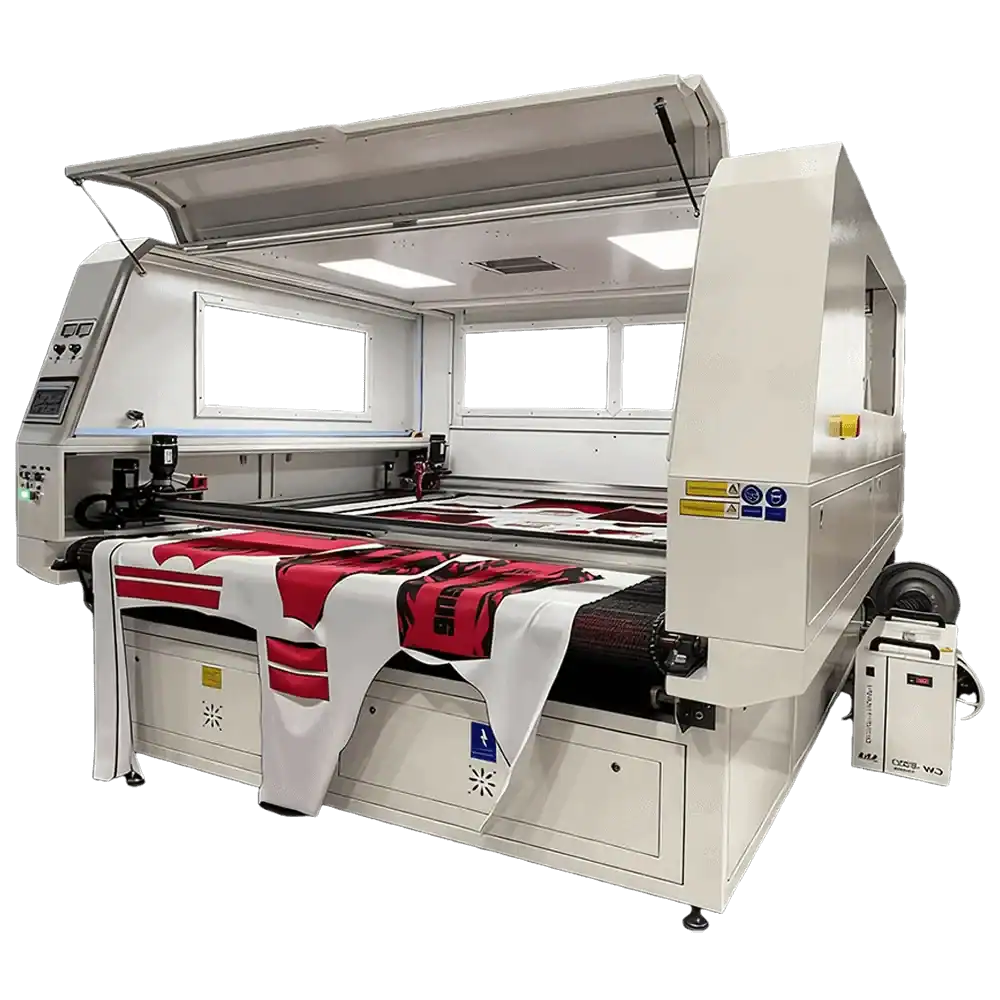
Continuous conveyor bed with synchronized roll feeding, wide-area optical camera scanning, and dual independent cutting heads built for tension-free cutting of printed stretch textiles.
2. Single-Ply Digital Flatbed Cutters and Multi-Tool Platforms
A single-ply digital cutter mounts interchangeable mechanical tool heads onto a CNC gantry over a vacuum flatbed or conveyor. Operators swap three primary tools depending on the job. Electric or pneumatic oscillating tools (EOT or POT) drive a vertical blade up and down at high frequency (rated in cycles per minute or Hz, with stroke length set by the tool holder) to slice dense woven textiles and leather. Driven rotary tools (DRT) spin a motorized polygonal or circular wheel at high RPM to roll through single-ply technical weaves with minimal pull. Tangential drag knives and motorized punches handle vinyl stencils and repetitive bolt holes. While operators frequently refer to these machines as single-ply tables, a heavy-duty oscillating knife head can slice low-ply stacks (typically 1 to 5 layers) over a breathable felt mat. Even so, their flatbeds lack the deep vacuum compression and self-sharpening vertical blades required for bulk apparel stack cutting. Plants run these multi-tool tables for R&D sampling, custom upholstery, natural-fiber apparel, and composite prepregs that need a cold edge.
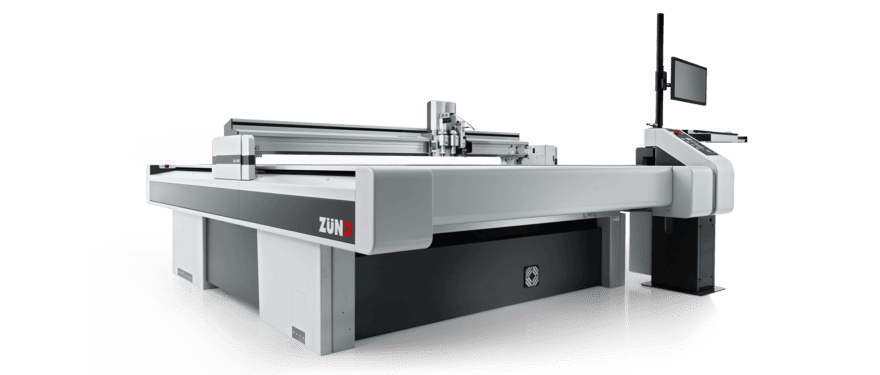
Vacuum flatbed, CNC gantry, and modular multi-tool head. Third-party product image from zund.com.
3. Apparel High-Ply Automated CNC Cutters
Unlike modular flatbed knife tables, high-ply cutters (such as the Lectra Vector or Gerber Paragon series) are heavy-duty garment room systems built around an interlocking nylon bristle-block bed, an inline automated spreading table, and an automatic blade-sharpening head. Before the blade ever drops, spreading machines lay 10 to 50+ fabric plies down the long table and seal the stack under polyethylene vacuum film. The gantry bridge then drives a long, rigid vertical reciprocating blade straight into the bristle bed to shear the compressed stack in a single pass. Optical scanners on these lines can align repeating stripes and plaids across a stack, though stacked cutting cannot handle unique one-off digital prints where every jersey panel carries a different player name. High-ply machines dominate bulk blanking for suits, denim, uniforms, and standard white apparel blanks.
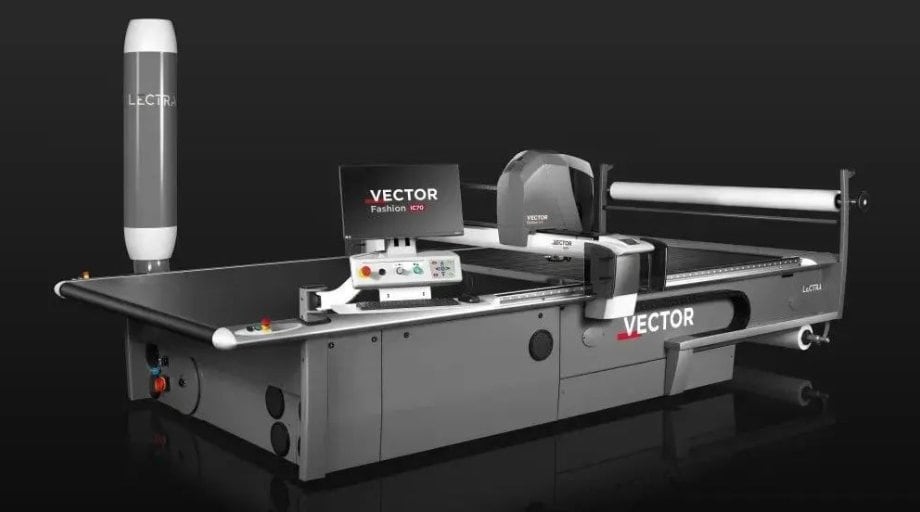
Long spreading table, vacuum-compressed fabric lay, and bridge-mounted reciprocating head. Third-party product image from lectra.cn.
Because oscillating knives, rotary wheels, and high-ply reciprocating bridges solve different problems, any fair benchmark has to pit a vision laser against the exact knife configuration built for that same job.
3. Operating Physics and Fiber Chemistry
How a fabric reacts in the cut zone comes down to polymer chemistry. A 10.6 µm infrared beam cuts by photothermal ablation, while a steel or carbide blade cuts by mechanical shear.
1. Melt-Sealable Synthetics (Polyester, Polyamide, and Polypropylene)
Thermoplastic polymers with defined melting points absorb the 10.6 µm CO2 wavelength readily. Heat melts and vaporizes the polymer inside a narrow kerf, and as the beam moves on, the molten edge cools into a microscopic bead that locks the yarn ends together. That sealed rim stops filaments from unraveling when operators pick up panels, bundle kits, and feed sewing machines.
A mechanical knife slices those same synthetic yarns cold and leaves the filament tips open. On tightly knitted interlock fabrics, an open edge holds together fine, whereas loosely woven synthetics will fray unless you add overlock stitching, hem folding, or ultrasonic binding.
One caution applies across synthetic spec sheets. Do not assume every synthetic polymer melts cleanly like polyester. Acrylic and polyacrylonitrile (PAN-based) fibers, aramids, blended weaves, and chemical coatings need their own thermal and fume tests before production. Standard acrylic decomposes instead of melting smoothly, which leaves a charred edge rather than a clean seal.
2. Cellulosic Fibers (Cotton, Linen, Hemp, and Viscose or Rayon)
Cellulosic fibers have no reversible melt phase. Hit cotton or linen with a laser beam and the cellulose undergoes pyrolysis and carbonization. On white or pastel cotton, the heat leaves an amber or yellow halo along the cut line along with wood-smoke odor. High-speed cutting passes and nitrogen assist gas can narrow that heat tint, yet cellulose stays sensitive to thermal marking.
A mechanical blade cuts cellulosic fabrics cold. The edge comes off the table with zero yellowing, zero heat stiffening, and zero smoke smell, which is why digital knives remain the standard tool for denim, raw cotton canvas, and linen.
3. Protein Natural Fibers (Silk, Wool, and Cashmere)
Animal protein fibers are built from keratin and fibroin. Laser heat scorches both proteins immediately, leaving a brittle, discolored edge and a strong smell of burnt hair. Mechanical knives slice silk chiffon, tailored wool suiting, and thick wool felt cleanly without damaging the fiber structure.
4. High-Elasticity Knits (15% to 25% Spandex or Elastane Blends)
Cycling kits, swimwear, and compression activewear rely on 4-way stretch knits loaded with elastane. Because a laser beam applies zero physical force to the fabric, it cannot drag or pull elastic yarns out of shape during a corner turn. Final piece accuracy still depends on how well you relax the roll beforehand and how evenly the feeder, vacuum bed, and exhaust airflow hold the knit.
Cutting a single ply of high-stretch spandex with a vertical reciprocating knife is trickier because lateral blade friction can tug the elastic loops and distort sharp corners. Knife table builders counter that pull by switching from a vertical oscillating blade to a Driven Rotary Tool (DRT), which rolls through the knit with rotational shear instead of dragging across it. When cutting loose or slippery elastane blends, operators can also lay a thin sacrificial polyethylene overlay film on top of the fabric so the vacuum pump seals the knit flat against the table.
5. Chlorinated Polymers and PVC-Coated Fabrics
Materials containing polyvinyl chloride (PVC), including vinyl banners, heavy tarpaulins, and PVC-coated faux leathers, must never go under a laser beam. Heating PVC releases toxic, corrosive hydrogen chloride (HCl) gas. As soon as HCl hits humidity in the room, it forms hydrochloric acid vapor that pits linear guide rails, ruins bearings, fogs ZnSe optics, and endangers anyone breathing shop air.
Mechanical knives cut PVC tarpaulins, vinyl signage, and rubberized composites cold without releasing acid gas. Shops cutting composites with knives still need standard dust extraction and blade guards, and the chemical decomposition hazard disappears.
4. Edge Quality, Anti-Fraying, and Skin-Contact Hand-Feel
Sales brochures for laser cutters sometimes imply that thermal edge sealing removes sewing or serging from the factory floor. In reality, plant engineers have to separate raw-edge fray control from structural seam strength and skin comfort.
Raw-Edge Fray Control vs. Structural Seams
When a laser melts the tips of a polyester weave together, it stops loose threads from pulling out while bundles move through the sewing line. On single-layer soft signage, flags, applique patches, and heat-bonded pocket details, that fused rim is the finished edge, saving a separate hemming pass.
Joining panels on a stretch garment is a different mechanical problem. A melted edge does not hold two pieces of cloth together or stretch with a rider's knee. Activewear seams still need 4-needle 6-thread flatlock stitching, stretch overlock seams, or heat-bonded seam tape to survive tensile pull.
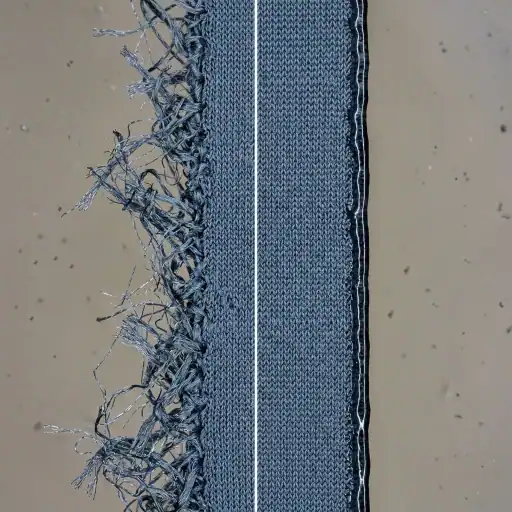
Left Mechanical knife cut showing open fiber tips and loose filaments.
Right CO2 laser thermal cut showing a fused polymeric micro-bead locking synthetic yarn filaments together.
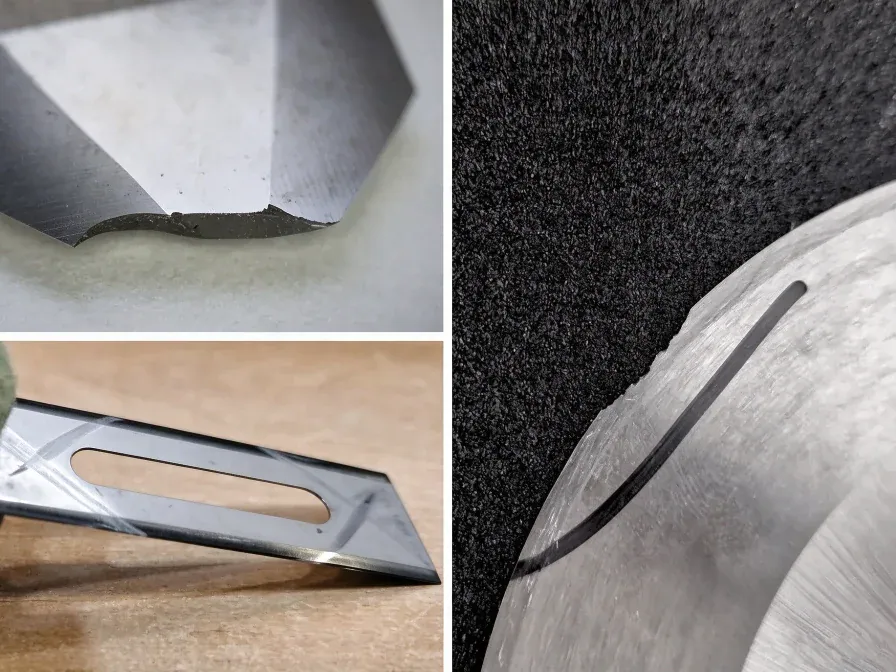
Tungsten carbide oscillating blade tip fracture (top left), fresh cutting bevel (bottom left), and rotary blade wear (right) after extended cutting cycles on abrasive fabric.
Tactile Hand-Feel on Skin-Contact Activewear
As molten polyester or nylon cools behind the laser spot, surface tension pulls the liquid polymer into a tiny bead along the yarn tips. Whether a customer ever notices that bead depends on how tight the garment fits.
On loose soccer jerseys, basketball shorts, running singlets, and outer shells, a micro-melted rim sits away from the body or inside a seam allowance and passes wear tests easily. Tight compression gear is much less forgiving. Think about a pair of cycling bib shorts or a triathlon suit rubbing against sweaty skin through thousands of pedal strokes. If the laser parameters run too hot, that solidified polymer rim feels hard and chafes the wearer's thighs, neck, or underarms.
A mechanical knife leaves the yarn tips cold and open, so the cut edge keeps the exact softness and stretch of the base knit. If you cut compression gear on a laser, your process engineer has to dial in laser power, pulse frequency or modulation, cutting speed, and assist airflow through fabric trials to shrink the heat-affected zone (HAZ). Good parameter tuning softens the bead considerably, yet any edge that rubs bare skin for hours (bib leg openings, necklines, armholes) should still get an overlock stitch or folded binding. Treated that way, the laser bead prevents fraying during assembly while the stitch handles skin comfort. Regardless of how you cut, validate the finished seam with ISO 6330 wash cycles and tensile pull tests.
5. Optical Vision Registration and Distortion Compensation
Sublimation transfer heating shrinks and skews polyester fabric, so static cutting paths rarely line up with printed rolls coming off the calender. When evaluating vision systems, keep two engineering realities in mind. Overhead camera registration is available on both vision lasers and high-end digital knife tables, which makes optical registration a software and camera choice rather than a laser exclusive. At the same time, steering a cutline to follow a shrunken print changes the physical dimensions of the cut piece, so your factory technical pack has to specify whether graphic borders or garment sizing take priority.
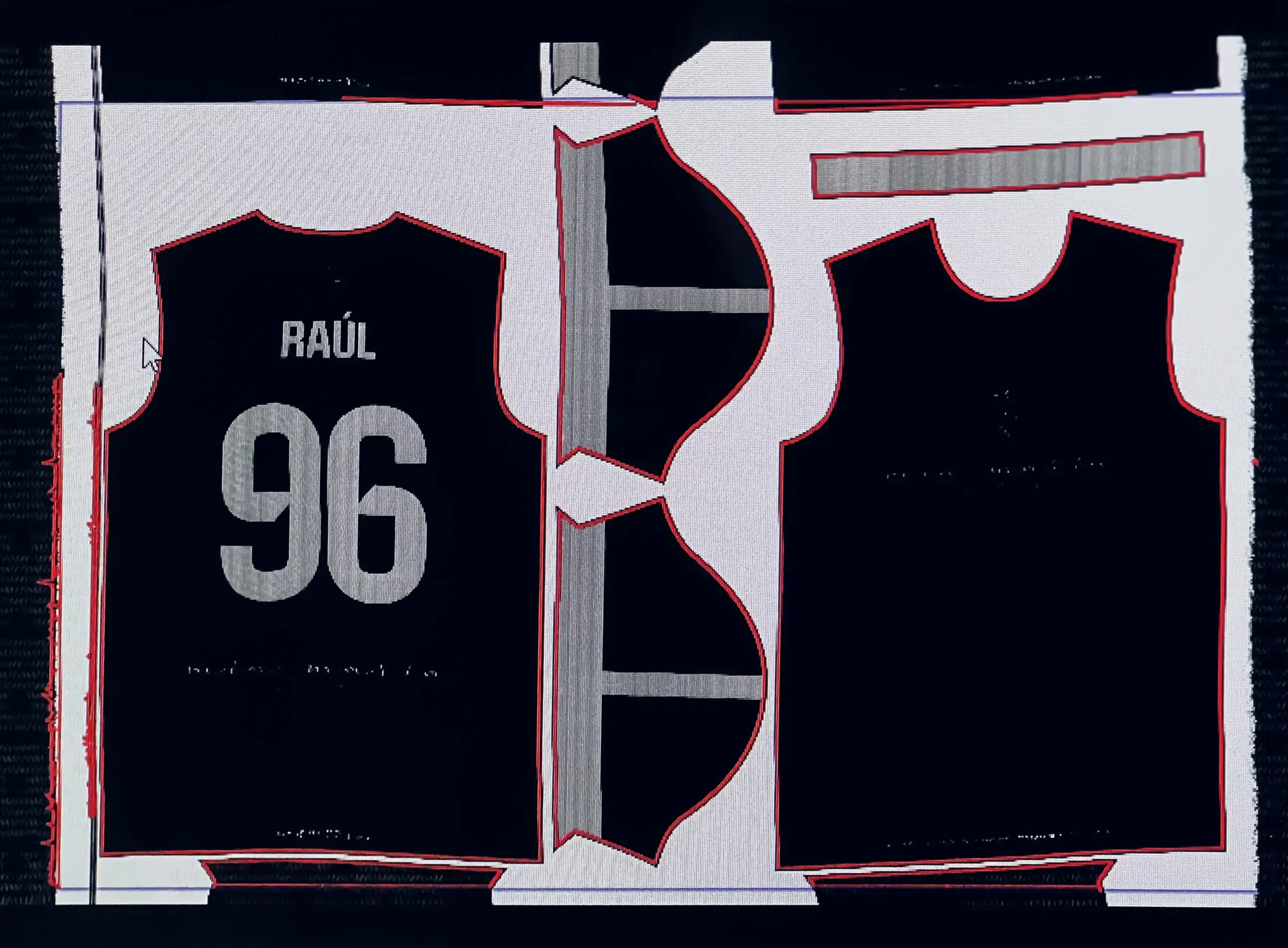
Vision software scans printed sportswear panels on the conveyor, maps non-linear shrinkage and skew across elastic rolls, and adjusts vector cutlines to follow printed edges.
Why Camera Registration Works on Both Platforms
You will occasionally hear vendor reps claim that knife cutters only run blind CAD files while lasers have dynamic vision. That claim is outdated. High-end single-ply knife tables (such as Zünd tables equipped with the Over-Cutter Camera (OCC) and MindCut Studio, as well as systems from Lectra and Kuris) mount overhead optics that read fiducial registration marks, extract printed contours, and warp cut paths on the fly.
How accurately a machine tracks a distorted print depends on camera resolution, lens calibration, lighting uniformity, recognition algorithms, and how flat the feeder lays the fabric. Whether the gantry drops a carbide blade or fires an infrared beam comes second.
Print Alignment vs. Final Garment Sizing
Tracing a shrunken print solves a visual problem while creating a sizing problem. Suppose a jersey back panel leaves the CAD system at 500 mm long, then shrinks to 485 mm coming out of the heated rotary calender. If your vision cutter dutifully hugs the shrunken ink border, the graphic looks clean with no white slivers, and the cut panel is now 15 mm short of the buyer's size spec.
When writing technical packs or auditing vendor software, engineers have to specify one of three compensation strategies. Note that not every machine controller builds all three modes into a toggle switch; some require upstream CAD pre-scaling.
- Print-Priority Compensation (Graphic Alignment) deforms the vector cutline to hug the outer edge of the printed ink. This prevents ugly white borders and clipped logos, at the cost of letting panel dimensions and seam lengths drift with fabric shrinkage.
- Dimension-Priority Compensation (Sizing Alignment) locks the cut path to the master
CADpattern geometry, grading rules, and target seam lengths. The garment sews together to the right size, though heavy fabric shrinkage can cause the toolpath to slice into the artwork or expose unprinted white cloth unless the artist added generous bleed margins. - Constrained Compensation (Parametric Blending) sets hard tolerances in the software (where supported) so the path scales within an allowed window along mated seams and flags any panel that shrank past the rejection limit. If the machine controller lacks parametric limits, quality teams must enforce those bounds through pre-shrinking tests and
CADshrinkage offsets.
6. Single-Ply Customization vs. Multi-Ply Bulk Production
Order volume and graphic variety dictate whether a factory makes money cutting one layer at a time or fifty layers at once.
Single-Ply Processing on Lasers and Flatbed Knives
Print-on-demand (POD) sportswear and mass customization live on single-ply conveyors. When every jersey on a roll carries a different player name, squad number, sponsor layout, and size grade, you have to cut each panel individually off the roll.
Lasers stay in the single-ply lane for a physical reason as well. If you stack multiple plies of polyester or nylon under a CO2 beam, heat conducting through the kerf welds the adjacent layers together along the cut line. Running a single ply at high gantry speed gives you clean, separate panels straight off the belt.
Multi-Ply Blanking on High-Ply CNC Cutters
When an order calls for ten thousand identical white t-shirt bodies, military uniform panels, or standard bag blanks, cutting one layer at a time wastes floor space. High-ply CNC cutters pull heavy vacuum over stacked fabric lays (10 to 50+ plies), compressing the air out of the stack so a vertical reciprocating blade can shear dozens of identical panels in a single pass.
Raw fabric yield is tight on both platforms. A CO2 laser beam focuses down to a 0.10 mm to 0.20 mm spot and can cut common lines between adjacent parts. Modern high-ply knife systems with active blade-deflection sensors (such as the Lectra Vector series) also run zero-buffer nesting on standardized markers, packing parts edge-to-edge without gap waste.
When calculating multi-ply throughput, look past the peak linear speed on the spec sheet. Real floor-to-floor cycle time includes loading heavy rolls onto the spreader, laying out fifty plies without tension waves, aligning edges, pulling vacuum, tagging bundles, and sorting cut parts for the sewing line.
7. Apparel Sublimation Workflows ("Print-First" vs. "Cut-First")
In dye-sublimation sportswear factories, where you place the cutting machine relative to the heat calender splits production into two distinct shop setups.
- Print-First runs digital transfer paper and white fabric rolls through the rotary heat calender together, lets the fabric shrink during transfer, scans the distorted print on a vision laser or vision knife conveyor, and sends cut pieces straight to sewing.
- Cut-First spreads unprinted white fabric in stacks, blanks cold-cut white panels on a multi-ply knife cutter, stores the relaxed white blanks in bins, lays each white piece by hand onto tacky printed paper with bleed borders entering the calender, and peels the paper off finished panels ready for sewing.
Inside Workflow A ("Print-First" Roll-to-Roll Sublimation + Vision Cutting)
In a Print-First line, wide-format printers output continuous rolls of transfer paper. That paper meets a continuous roll of white polyester inside a heated rotary drum calender, typically running at 190°C to 205°C for 25 to 35 seconds depending on ink and paper chemistry. Once the dye sublimates into the polyester fibers, the printed fabric roll moves directly to the auto-feeder on a vision conveyor laser or single-ply vision knife.
This setup cuts out manual piece handling at the calender and works well for fast-turn teamwear, promotional flags, soft signage, and intricate all-over graphics. The main engineering headache is fabric distortion. Unwinding tension plus 200°C drum heat shrinks and skews elastic knits unevenly across the web width, which is why the vision cutter at the end of the line must track non-linear distortion accurately.
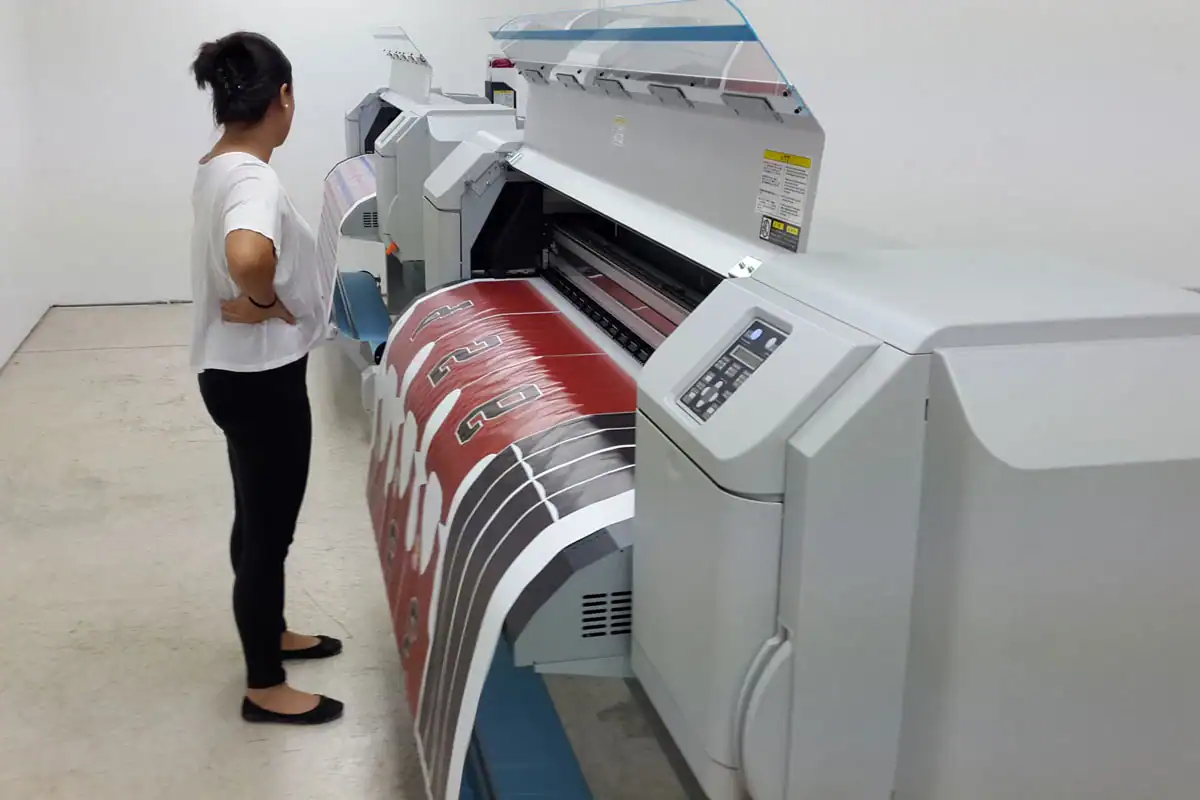
High-speed sublimation paper plotters preparing continuous rolls for rotary calender heat transfer ahead of optical conveyor cutting.
Inside Workflow B ("Cut-First" Bulk Blanking + Cut-Piece Transfer)
In a Cut-First plant (used by custom cycling manufacturers like Kalas Sportswear), unprinted white rolls go straight to the spreading table and multi-ply CNC knife cutter. Operators stack and barcode the cold-cut white panels as standard inventory. When a custom team order arrives, printers output transfer paper with an extra ink bleed around every panel shape. Workers standing at the calender infeed table lay the pre-cut white blanks face-down onto the tacky transfer paper. Once the paper and panels exit the heated drum, operators peel away the waste paper and hand the finished panels directly to the sewing floor without any post-print cutting.
Cut-First trades post-print cutting equipment for manual placement labor at the calender. Because the white panels are sliced with a cold mechanical blade before printing, every skin-contact edge on a cycling bib or jersey stays soft and unmelted, and factories can cut white blanks in bulk ahead of peak season.
Cutting white fabric cold before the calender also removes roll-unwinding tension during the cutting step, though thermal shrinkage still happens the moment those white panels enter the 200°C calender drum. Tacky transfer paper helps hold the knit flat during heating, yet pattern makers still have to measure drum shrinkage and post-cooling relaxation so they can build accurate shrinkage offsets into the master CAD pattern.
That pre-cut workflow also makes multi-fabric gang printing practical. A single cycling jersey often combines solid micro-polyester body panels, open-pore mesh side panels, and ribbed compression sleeves. On a Cut-First line, an operator can lay pre-cut blanks from all three fabric rolls onto one gang-printed sheet of transfer paper in a single calender pass, provided the selected textiles, inks, papers, and transfer settings share a validated operating window. When comparing Print-First and Cut-First defect rates, test both workflows under the exact same seam allowance, artwork bleed margin, placement tolerance, and rejection criteria. Bleed margins absorb minor placement drift on the calender table, though they still require disciplined operator alignment.
Factory Case 4-Stage "Cut-First" Execution (Kalas Sportswear Custom Cycling Production)
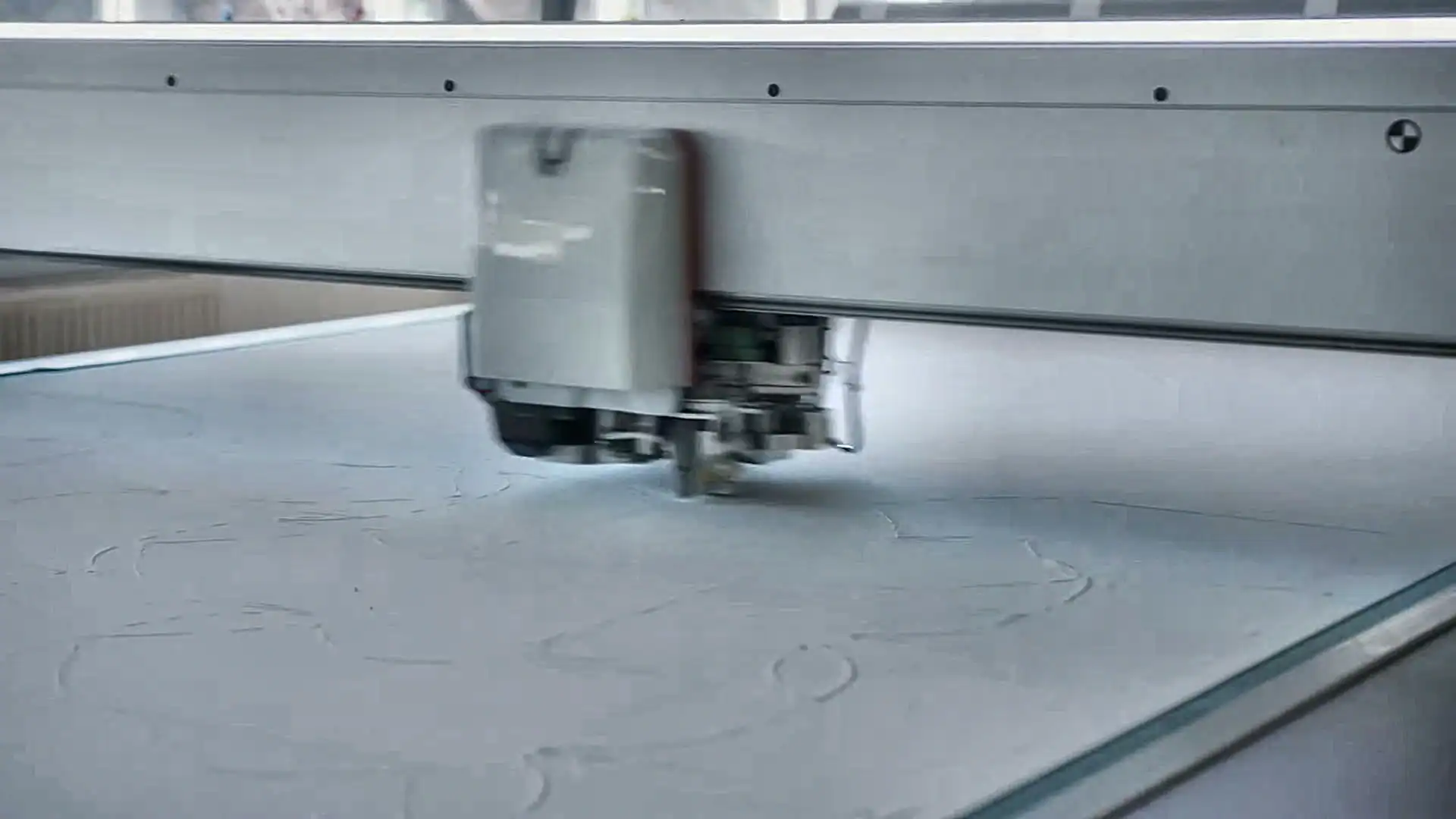
Automated knife cutting table slicing unprinted white fabric plies under vacuum.
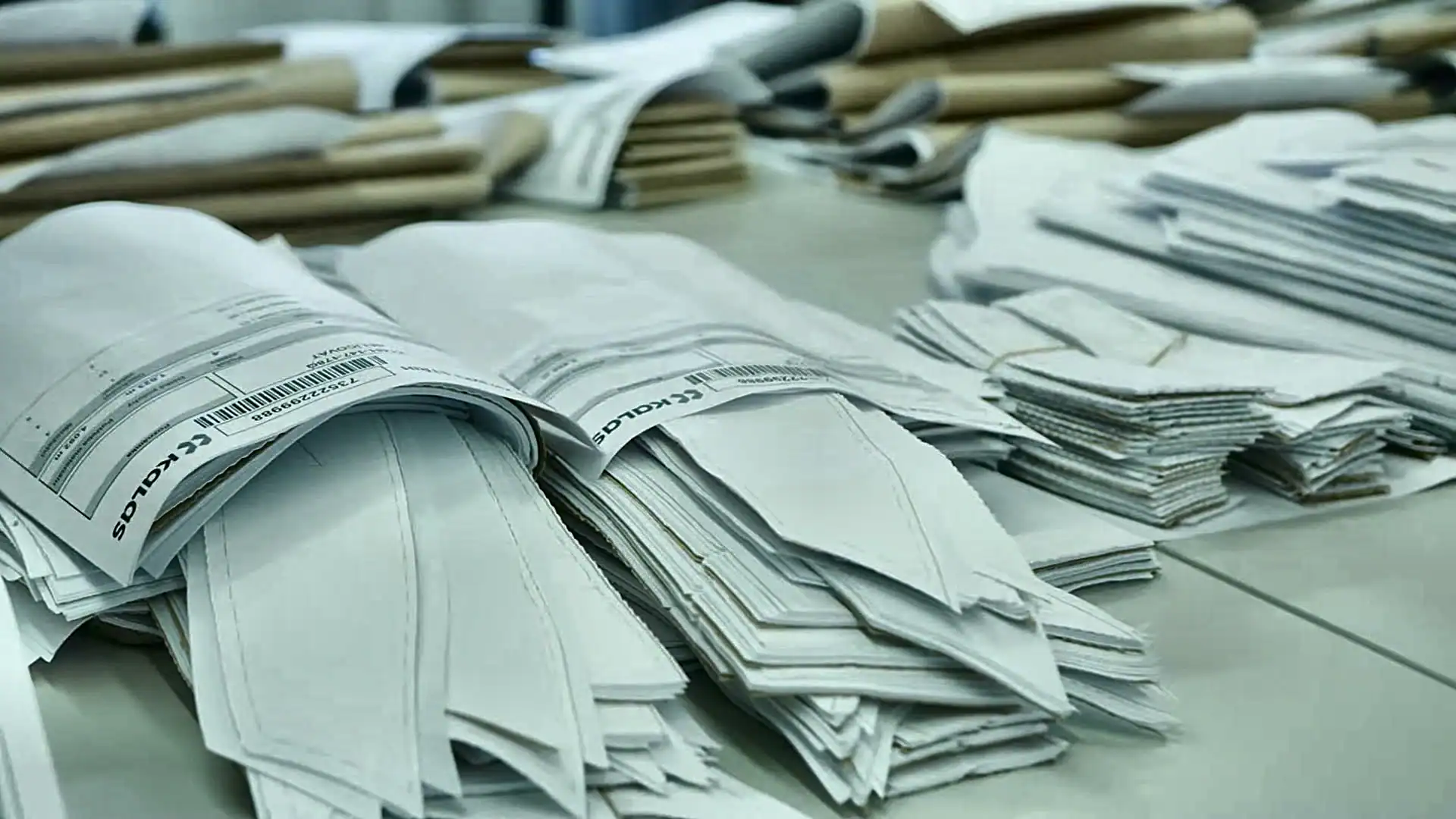
Pre-cut white panels bundled with barcodes, staged for rapid transfer on demand.
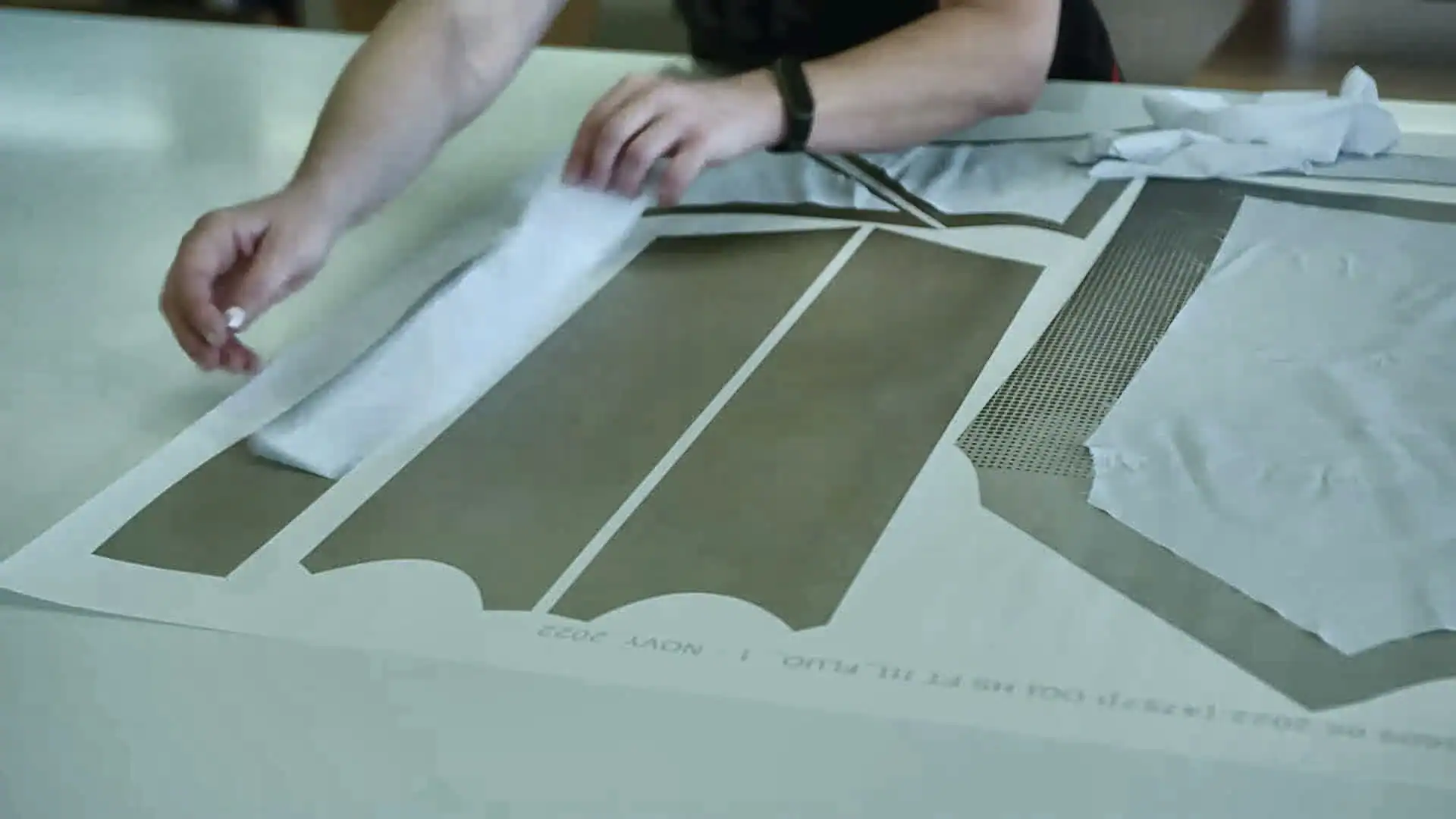
Worker placing pre-cut white blanks onto printed tacky paper inside ink bleed borders.
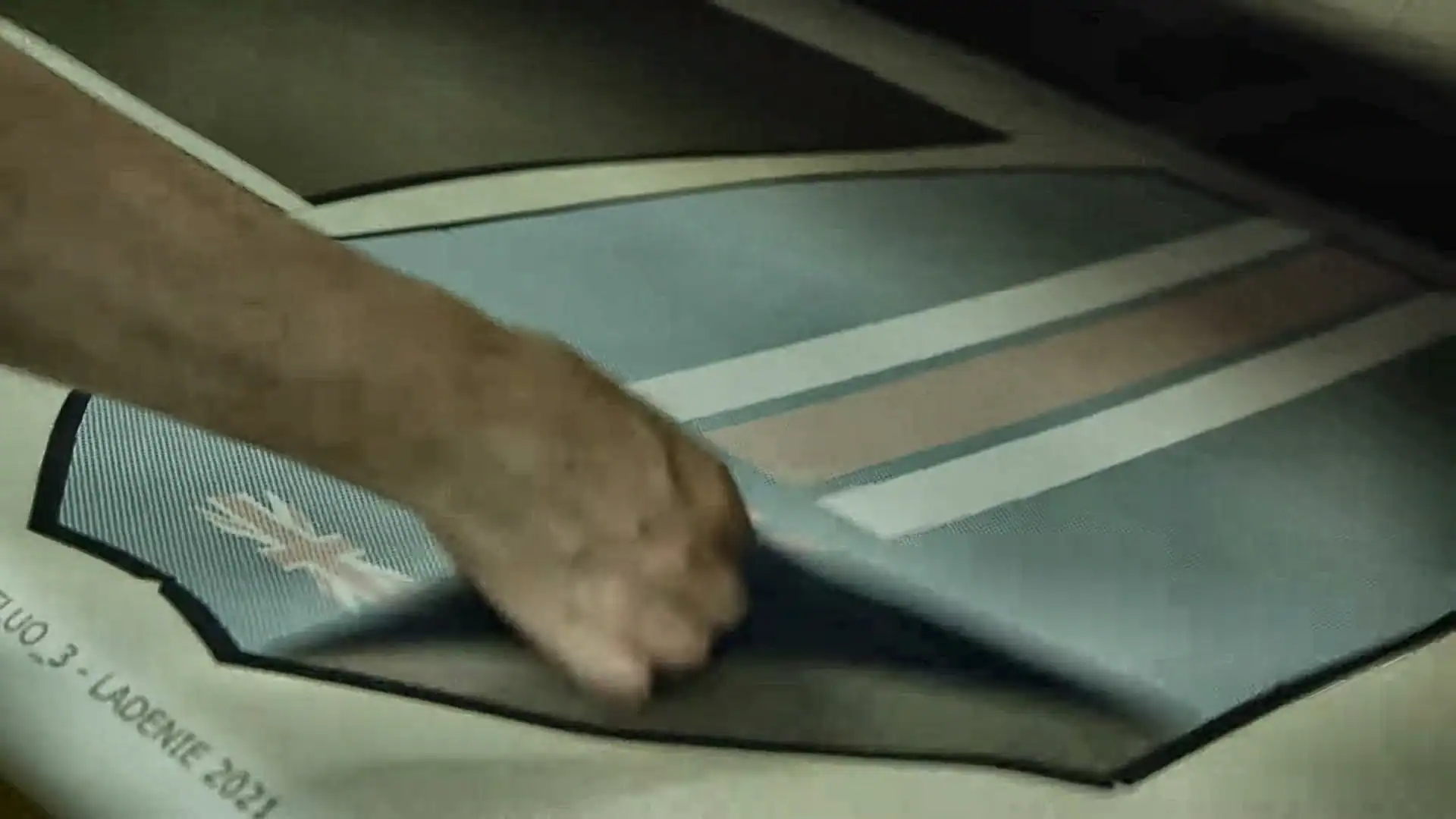
Peeling transfer paper after the calender so the panel goes straight to sewing without post-cutting.
8. Geometric Capabilities, Micro-Perforations, and Corner Clearances
The physical size of your cutting tool sets hard mechanical limits on how small a hole or how tight an inside corner you can cut.
| Dimension | Focused Laser Optical Spot | Mechanical Blade Cutting Unit |
|---|---|---|
| Cutting agent | Spot diameter 0.10-0.20 mm | Reciprocating or rotary steel/carbide blade |
| Surface contact | Non-contact optical beam | Physical blade body and cutting bevel |
| Turning clearance | Zero blade-width turning clearance | Requires tangential C-axis steering |
| Micro-perforations | Pulses sealed micro-holes on the fly | Uses dedicated mechanical punch dies for small holes |
Micro-Ventilation Perforations in Performance Apparel
Technical sportswear designers often replace mesh inserts by cutting breathable hole arrays right through the main body fabric across the spine, chest, and underarms.
A CO2 laser handles this by pulsing rapid micro-bursts as the head flies across the panel, opening 0.8 mm to 2.0 mm ventilation pores while melting the rim of each hole so the knit cannot run. Before signing off on a perforated pattern, engineers still need to run warp and weft tensile pull tests to make sure the hole spacing does not tear under load.
Cutting hundreds of 1.0 mm holes with an oscillating knife blade is impractical because the steel blade has physical width and vertical plunge depth. On a digital knife table, small circular holes are punched using a motorized punch module fitted with hollow steel dies (or drilled with heavy-duty mechanical drill spindles on high-ply cutters).
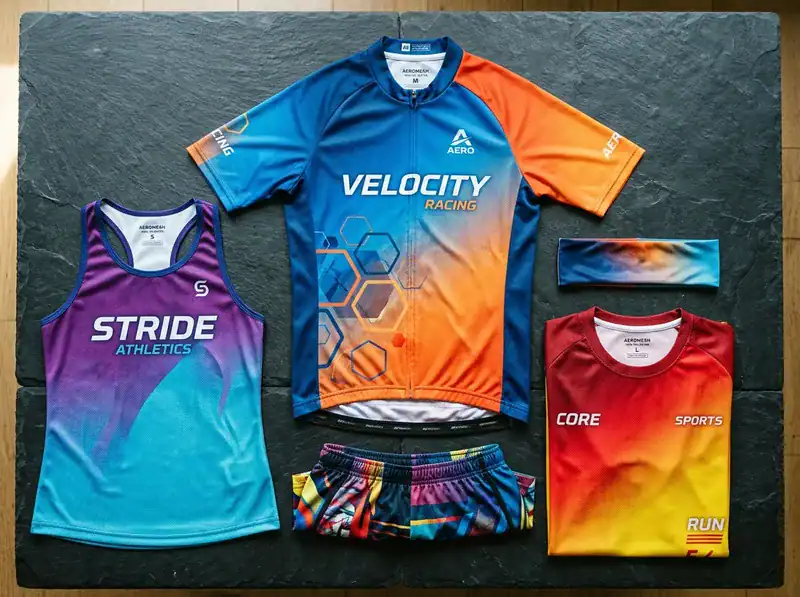
Multi-panel cycling kit featuring zoned breathability knits, laser-perforated ventilation pores, and high-stretch ergonomic seams.
Acute Internal Corners and Intricate Notches
Because a focused laser spot measures 0.10 mm to 0.20 mm across with no physical blade belly, it turns sharp V-notches and acute internal corners without overcutting. Spot size, gantry deceleration, and local heat buildup set the fine detail limit.
A mechanical knife blade has flat width and an angled cutting bevel buried in the cloth. To turn a sharp corner without slicing past the apex, the CNC controller has to decelerate, lift or pivot the tangential C-axis to aim the blade along the new vector, and manage bevel overcut in software.
9. Three-Way Technical Comparison Matrix
| Engineering Factor | Industrial CO2 / Vision Laser | Single-Ply Digital Knife Table | High-Ply Automated CNC Cutter |
|---|---|---|---|
| Cutting Physics | Non-contact photothermal ablation (10.6 µm IR beam) | Mechanical contact vertical reciprocating shear or driven rotary shear | Heavy-duty mechanical reciprocating vertical blade shear |
| Edge Finish (Synthetics) | Heat-sealed micro-bead that resists fraying during handling | Cold cut leaving synthetic yarn tips open and unsealed | Cold cut leaving unsealed edges across all stacked plies |
| Edge Finish (Naturals & Protein) | Yellow heat halo on cellulose (cotton) and scorching on protein fibers (silk/wool) | Clean cold cut with zero thermal marking | Clean cold cut built for high-volume natural fiber lays |
| Tactile Edge Hand-Feel | Fused polymer bead requires parameter tuning and overlocking on skin-contact bibs | Soft, unmelted fiber tips that preserve native knit hand-feel | Soft, completely cold edges across the stack |
| 4-Way Stretch Knits | Zero blade-contact drag (still requires tension-free feeding) | Uses driven rotary tooling (DRT) and vacuum hold-down to prevent pull | Heavy vacuum compresses and locks the multi-ply lay in place |
| Stack Capacity | Single-ply or limited-ply (heat welds stacked synthetics together) | Single-ply to low-ply (typically 1 to 5 layers depending on tool) | High-ply (typically 10 to 50+ compressed plies depending on model) |
| Optical Registration | Overhead camera vision compensates for non-linear shrinkage | Camera vision available (such as Zünd Over-Cutter Camera) | Built for repeatable stacked markers and stripe/plaid matching |
| Micro-Vent Perforations | Pulses sealed 0.8-2.0 mm holes dynamically on the fly | Uses dedicated motorized punch dies for small circular holes | Uses specialized high-ply mechanical drill spindles |
| Cutting Speed (Vector) | High speed on intricate curves and small features, governed by laser wattage | Up to 1,000 mm/s manufacturer rating with driven rotary tools (Zünd DRT), slower with oscillating blades | Moderate linear gantry speed multiplied across 10 to 50+ stacked layers |
| Material Incompatibility | Strictly prohibits PVC and vinyl (releases toxic, corrosive HCl gas) | Cuts PVC and vinyl cold without thermal decomposition | Cuts PVC and synthetic stacks cold without thermal gas release |
| Consumable Tooling | Zero blade wear; laser tube life depends on duty cycle and chiller control | Regular carbide blade swaps and sacrificial felt mat resurfacing | Frequent blade sharpening/replacement, grindstone wear, and bristle blocks |
| Facility Infrastructure | Requires external exhaust ducting or multi-stage HEPA/carbon filtration | Requires high-airflow vacuum hold-down turbine and acoustic management | Requires heavy 3-phase vacuum turbines and long spreading table bays |
| Capital & Labor Profile | Moderate capital outlay; automated roll feeding minimizes operator labor | Mid-to-high capital outlay; ongoing blade/mat consumables and vacuum power draw | High capital outlay; requires dedicated spreading and bundle-sorting operators |
10. Operating Cost Drivers, TCO Math, and Maintenance Realities
Evaluating equipment strictly on machine sticker price misses the recurring factory bills for capital depreciation, consumable tooling, electrical draw, and operator labor. A realistic multi-year total cost of ownership (TCO) model measures cost per accepted garment kit across five operational buckets rather than raw gantry speed.
Cost per accepted garment kit
  = (Capital Depreciation + Consumable Tooling + Electrical Load + Maintenance + Floor Labor)
/ Total accepted garment kits within specification- Capital Equipment Outlay (
Ownership) scales sharply by machine class. High-ply automated CNC cutters paired with automated spreading lines sit at the top of the capital budget, premium European single-ply multi-tool tables occupy the middle-to-high tier, and industrial CO2 vision laser conveyors typically offer the lowest entry price per cutting station.
Digital CNC Knife Cutter Cost Drivers
Mechanical cutters concentrate their recurring expenses in physical wear tooling, high-amperage vacuum power, and material handling labor.
- Consumable Tooling (Blades, Mats, and Bristles) wears down from direct mechanical friction. Tungsten carbide oscillating and rotary blades dull and chip rapidly when slicing abrasive weaves like ballistic nylon, aramid, fiberglass, or heavy canvas, requiring scheduled blade swaps. Below the cloth, the blade tip scores the sacrificial bed on every pass—grooving felt conveyor belts on single-ply tables and chewing up nylon bristle blocks and sharpening grindstones on high-ply cutters until vacuum pressure leaks and forces mat replacement.
- Electrical Load (Vacuum Hold-Down Turbines) dominates the utility bill. Pulling enough negative pressure to lock down porous knits or compress 50-ply stacks requires high-kilowatt 3-phase vacuum blowers running continuously across the shift.
- Floor Labor and Cycle Efficiency extend beyond cutting speed. While a high-ply cutter slices dozens of layers at once, total labor hours must account for loading fabric rolls onto the spreader, laying tension-free stacks, pulling vacuum film, and manually sorting bundled parts for the sewing line. Mechanical tool heads also carry high-frequency reciprocating linkages and
C-axisbearings that require scheduled greasing and rebuilds.
Industrial CO2 Laser Cutter Cost Drivers
Because an infrared beam never touches the textile, a laser cutter eliminates blade and mat bills altogether, shifting operating costs toward laser source amortization, chiller and exhaust electricity, and optical upkeep.
- Consumables (Laser Source and Filtration Media) replace mechanical blades. A laser never grooves the conveyor belt, so consumable budgets go toward periodic replacement of pre-filters,
HEPAcartridges, and activated carbon beds inside the fume extractor, alongside multi-year amortization of theDCglass laser tube or sealed metalRFlaser source (governed by duty cycle and chiller water temperature stability). - Electrical Load (Laser Source, Water Chiller, and Exhaust Blowers) stays significantly lower than a heavy multi-ply vacuum turbine, drawing power primarily for the laser resonator, closed-loop water chiller, and high-static centrifugal exhaust fan (such as a
750W to 1500Wradial snail blower). - Labor Efficiency and Preventive Optical Care favor continuous roll-to-roll automation. Automated tension-free feeding and vision scanning allow one operator to supervise multiple single-ply laser conveyors simultaneously. In exchange, operators must spend a few minutes per shift wiping smoke residue off the mirrors and
ZnSefocusing lens with approved optical solvent and verifying beam alignment so cut power never drops. Across both laser and knife installations, plant engineers should also verify occupational noise exposure from vacuum turbines and extraction blowers under actual operating load.
11. Standardized Sample Evaluation Protocol
Never sign a purchase order based on nominal datasheet speeds or a vendor's pre-cut sample swatch. Ship rolls of your own production fabric to each vendor and measure the returned panels across four defined testing states.
1. Four Checkpoints for Repeatable Measurement
To keep measurements repeatable across machines, inspect dimensional accuracy and edge hand-feel in the exact sequence that matches your production workflow.
- As-Cut State measured right off the cutting bed before further heat or handling.
- Post-Transfer and Cooled State (for Cut-First trials) measured after the panel exits the rotary calender and rests flat down to room temperature.
- Relaxed State measured after conditioning the panels under controlled temperature and humidity per
ISO 139:2005standard atmospheres, logging exact conditioning hours. - Post-Laundering State measured after running the complete domestic wash and dry cycle specified on the garment care label per
ISO 6330:2021.
2. Inspection Criteria and Target Tolerances
| Evaluation Item | Agreed Inspection Method | Target Acceptance Metric |
|---|---|---|
| Contour Dimensions | Measure cut perimeter and key panel widths against the master CAD pattern. | Within buyer sizing tolerance (typically ±1.0 mm to ±2.0 mm). |
| Seam Pairing Lengths | Compare mating seam lengths between adjacent panels (front and back side seams). | Length mismatch within sewing tolerance (typically ≤1.5 mm). |
| Edge Finish & Fraying | Run cut and sewn panels through ISO 6330 wash and dry cycles. | Zero yarn unraveling, filament pull-out, or seam tape delamination. |
| Edge Tactile Comfort | Run a wearer sensory trial on skin-contact hems (cycling bib leg openings and necklines). | Zero chafing or scratchiness across the defined activity, duration, and fit test. |
| Visual Edge Appearance | Inspect white and pastel edges under a D65 standard light booth. | No visible amber heat halo, soot residue, or charred fibers. |
| Post-Cooling Odor | Smell-test stacked cut panels after cooling and conditioning. | No lingering combustion smoke or chemical odor trapped in the stack. |
| Perforation Integrity | Pull-test micro-perforated zones along both warp and weft directions. | No crack propagation or web tearing between holes under cyclic load. |
| Effective Throughput | Time complete garment kits per hour including roll loading, camera scanning, and takeoff. | Hits hourly kit target while meeting all dimensional and edge specs. |
3. Keeping the Benchmark Fair
Run every vendor trial on rolls from the same fabric dye lot, using the same CAD marker and stopwatch boundaries, while letting each applications engineer tune their own laser parameters or knife tooling to match the cloth.
12. Five-Point Factory Procurement Checklist
When reviewing final equipment quotes, verify five engineering details before signing off.
- Audit your fiber chemistry mix. If your floor cuts mostly melt-sealable synthetics (polyester, nylon, and elastane blends), test industrial CO2 vision lasers for sealed edges and zero-drag cutting. If your schedule includes cotton, linen, wool, silk, or any PVC-coated material, put digital knife tables at the top of the list.
- Lock down your sublimation sequence and vision rules. Decide up front whether your plant will run Print-First roll-to-roll cutting or Cut-First blanking. For printed rolls, verify that the vendor's camera software supports your required compensation logic (Print-Priority, Dimension-Priority, or Constrained Blending).
- Check the exact tool head on knife quotes. Make sure single-ply digital knife proposals include Driven Rotary Tools (
DRT) for stretchy knits and Electric or Pneumatic Oscillating Tools (EOTorPOT) plus punch modules for dense canvas, leather, and small holes. - Verify utility hookups before delivery. Confirm that your building transformer and ductwork can handle the machine's background load, whether that means high-amperage 3-phase vacuum turbines for knife tables or water chillers and exterior exhaust blowers for CO2 lasers.
- Time a live trial on your own fabric. Skip generic demo videos and time a full roll-to-kit production run on your hardest stretch knit using the four-stage sample evaluation protocol above.
References and Technical Standards
- ISO 6330 (2021) Textiles, Domestic washing and drying procedures for textile testing. International Organization for Standardization. iso.org
- ISO 139 (2005) Textiles, Standard atmospheres for conditioning and testing. International Organization for Standardization. iso.org
- Zünd Systemtechnik AG Driven Rotary Tool (DRT) for Single-Ply Textiles. zund.com/en/cutting-systems/modules-and-tools/driven-rotary-tool-drt
- Zünd Systemtechnik AG Over-Cutter Camera (OCC) Optical Registration & Distortion Recognition. zund.com/en/cutting-systems/registration-methods/over-cutter-camera
- Lectra Fashion & Apparel Vector Series Automated Fabric Cutting Systems (Low-Ply to High-Ply with Pattern Matching & Anti-Deflection). lectra.com/en/fashion/products/vector-fashion
- CDC / NIOSH Health Hazard Assessment Evaluation of Chemical and Thermal Decomposition Products of Polyvinyl Chloride (PVC). National Institute for Occupational Safety and Health.
Explore production-proven laser systems engineered for flexible textiles, sportswear, and technical fabrics
- RedShift Vision Laser Cutter Series pairs wide-format optical cameras with continuous conveyor feeding to track sublimation distortion on the fly.
- CO2 Flatbed & Conveyor Laser Cutters automate tension-free roll feeding for apparel textiles, leather, acrylic, and industrial filtration media.
- Dye Sublimation Sportswear Turnkey Solution connects roll-to-roll print registration straight through to finished cut garment kits.