...

FAQ - Frequently Asked Questions

Expert insights and technical guidance on industrial laser cutting, marking, welding, and cleaning technologies.

Explore detailed answers regarding our equipment technology, material capabilities, and automation integration. If you cannot find the specific information you need for your production line, please feel free to reach out via our contact form or request a customized technical consultation with our engineering team.

Basics of Laser Technology

A: A laser emits a highly concentrated, intense beam of light generated through a process called stimulated emission. Unlike conventional light sources, laser light is monochromatic (possessing a single wavelength) and coherent (its light waves travel in phase). This unique property allows the beam to be focused down to a microscopic point, delivering massive energy to instantly melt, vaporize, or alter targeted materials.
A: A CO₂ laser relies on a specialized gas mixture—primarily carbon dioxide—to generate an invisible infrared beam with a wavelength of 10.6μm. This specific wavelength boasts an exceptionally high absorption rate for non-metallic materials. Consequently, it is the industry standard for efficiently cutting and engraving wood, acrylic, textiles, leather, and plastics.
A: Technically, the laser beam has no inherent temperature because it consists of massless photons. The intense heat is solely the result of the material absorbing the electromagnetic energy carried by the beam. The moment the laser strikes the substrate, this energy converts into thermal heat, instantly melting or vaporizing the targeted area.
A: Because the laser acts as a virtual tool, it never physically touches the workpiece. This eliminates mechanical friction, tool wear, and the necessity to forcefully clamp down the material. As a result, you can flawlessly process highly flexible or easily distorted materials, such as thin fabrics or technical films, without inducing any structural stress or fraying.
A: An assist gas flow is directed through the laser's cutting nozzle to immediately blow away vaporized residues and molten slag from the cutting kerf. Additionally, it cools the surrounding heat-affected zone to prevent material charring and creates a positive pressure shield that protects the delicate focusing lens from smoke and debris contamination.

Laser Safety & Class Certification

A: Industrial laser sources capable of cutting, welding, and cleaning materials are inherently classified as Laser Class 4 due to their massive power output. However, the safety of your operators is our absolute priority.
To ensure maximum safety, REDSHIFT systems can be configured so that the operating area strictly meets Laser Class 1 safety standards during normal operation. We achieve this uncompromising level of safety through:
  • Fully Enclosed Protective Covers: Unlike open-table designs, our enclosed machines completely surround the processing area. This robust physical barrier reliably blocks scattered laser radiation and protects operators from any direct exposure.
  • Smart Interlock Systems: Our machine doors and access panels are equipped with intelligent safety interlocks. If a door is accidentally opened while the machine is running, the laser system will instantly and automatically shut down to prevent any accidental radiation exposure.
  • CE Compliant Design: Our comprehensive safety concept is built to comply with stringent CE standards.
Conclusion: While the internal laser source delivers industrial-grade Class 4 power, REDSHIFT’s full encapsulation and interlock technology ensure that your factory environment remains completely safe. Your operators can run the equipment efficiently and without risk in a Laser Class 1 equivalent operating zone at all times.

Software & Technology Support

A: Our control systems, such as the Ruida RDC6445G, seamlessly integrate with industry-standard design software including AutoCAD, CorelDRAW, and Photoshop. You can directly import a wide variety of vector and bitmap formats, including DXF, AI, PLT, DST, BMP, and JPG.
A: Absolutely. For smaller, easily deformed materials like embroidery patches or woven labels, our CCD Laser Cutter utilizes a 1.3-megapixel camera to recognize contours and automatically adjust for physical distortions. For large-format digital dye-sublimation prints (like sportswear), our Vision Laser Cutter features a top-mounted 25-megapixel HD camera that scans the entire bed (up to 2000×3000mm) to automatically extract and cut contours without manual alignment.
A: Yes. Our Ruida control systems (RDC644X series and above) and RDWorks software support a "Scan-to-Process" function. By connecting a barcode scanner, the system can read the barcode on your work order and automatically retrieve the corresponding vector file (such as an .rld file) from a designated local folder. This eliminates manual file selection and drastically improves efficiency for mixed-batch or multi-order production.
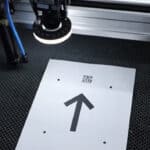
Redshift Ruida control systems (RDC644X series and above) and RDWorks software support a "Scan-to-Process" function

Material Capabilities & Automation

A: Yes, our Hybrid Metal & Non-metal Laser Cutter (such as the RZ-1390 model) is engineered precisely for this dual purpose. While it effortlessly processes non-metals like wood, leather, and acrylic, you can introduce oxygen or nitrogen as an assist gas to seamlessly cut through thin stainless steel and carbon steel.
A: For rolled textiles and technical films, we equip our machines with an automated feeding system and a specialized conveyor working table. A motorized tension system manages the feeding and automatically corrects deviations, keeping the continuous feeding error under 5mm for uninterrupted, hands-free production.
A: Yes. By fine-tuning the laser output or utilizing our 3D Galvo & Gantry Laser Machine, operators can execute high-speed kiss-cuts (half-cuts) and full cuts on technical films like PET, PU, and PVC, slicing through the top layer while leaving the backing completely intact.

Components, Lifespan & Add-ons

A: Lifespan varies by technology type. Standard glass CO₂ laser tubes typically last around 8,000 hours, whereas premium RF metal CO₂ tubes offer superior stability and exceed 20,000 hours of operation. For metal marking and processing, our Fiber and UV lasers utilize a solid-state, maintenance-free design that delivers an average lifespan of up to 100,000 hours.
A: To guarantee 24/7 stable operation, our medium-to-high power machines rely on high-precision constant-temperature water chillers, such as the CW-5200, CW-5300, and CW-6200 series. Conversely, lower-power fiber markers, UV markers, and our compact handheld laser welders feature highly efficient, maintenance-free air-cooling designs.
A: To boost throughput, you can upgrade from a single head to an independent dual-head system, where two laser heads move autonomously to cut different patterns, reducing processing time by 30% to 50%. For massive-scale manufacturing, we offer a dual-gantry six-head configuration capable of operating six cutting heads simultaneously.
A: Yes, our systems can be outfitted with an automated pen marking or inkjet system. This feature allows you to draw sewing lines, alignment marks, or part numbers directly onto the material, automatically switching between the drawing pen / inkjet and the laser cutter within the exact same job.

Laser Welding & Cleaning Technology

A: Handheld laser welding is up to 4 times faster than traditional TIG welding. It features an extremely small heat-affected zone, which practically eliminates material distortion even on thin metal sheets. Furthermore, it produces a smooth, aesthetically pleasing weld seam that requires zero post-weld grinding or polishing, saving significant labor and time.
A: Yes. REDSHIFT offers a versatile 3-in-1 Handheld Laser Welding Machine. By simply swapping out the specialized copper nozzles and adjusting the software parameters, operators can seamlessly transition between high-quality welding, thin metal cutting, and pre/post-weld rust or oil cleaning using the exact same handheld gun.
A: CW laser cleaning machines (1000W–3000W) are designed for large-area, high-efficiency tasks like removing heavy rust and paint from steel structures, bridges, and ship hulls. Pulse laser cleaning machines (100W–500W), on the other hand, utilize "cold cleaning" technology. They produce an extremely small heat-affected zone, making them perfect for delicate tasks like mold cleaning, historical artifact restoration, and precision parts degreasing, ensuring the base material suffers zero thermal damage.

Laser Marking & Precision Processing

A: Your choice depends entirely on the material:
  • CO₂ Lasers (10.64μm): Ideal for engraving non-metallic organic materials like wood, leather, paper, textiles, and acrylic.
  • Fiber Lasers (1064nm): The industry standard for high-contrast, permanent marking on all metals and certain tough industrial plastics.
  • UV Lasers (355nm/532nm): Utilizes "cold marking" technology to break molecular bonds without heat. It is specifically designed for highly heat-sensitive materials like glass, silicon wafers, ceramics, and delicate electronics.
A: Yes. For materials like breathable sportswear, automotive interiors, and technical films, we offer a hybrid 3D Galvo & Gantry Laser Machine. The high-speed Galvo head can punch up to 4,500 micro-holes per minute, while the traditional X-Y Gantry system simultaneously cuts the precise outer contours of the large-format fabric, maximizing your floor space and production efficiency.

Hardware Configurations & Worktables

A: The worktable heavily influences the cutting result:
  • Honeycomb Table: Provides excellent breathability and prevents material sagging. Best for thin, flexible, or small-piece materials like paper, leather, and fabric.
  • Knife Strip (Blade) Table: Features parallel aluminum bars to minimize laser reflection from underneath. Ideal for hard, thick materials like acrylic, MDF, and thick wood.
  • Conveyor Table: Equipped with a stainless steel mesh belt, it works in tandem with an auto-feeding system to enable continuous, automated cutting of rolled fabrics and flexible films.
A: High-power systems, such as medium-to-high wattage CO₂ cutters and Continuous Wave (CW) laser cleaners, require our high-precision dual-temperature water chillers (like the CW-5200 or CW-6200 series) to ensure 24/7 stable operation. However, we also offer air-cooled solutions for lower-power Fiber and UV markers, as well as specialized Air-Cooled Handheld Laser Welders, which completely eliminate the need for water cooling, making them highly portable for on-site jobs.

Installation & After-Sales Service

A: After your purchase, we provide a full-range service to get you free from any worry. We offer support that is specifically adapted to your laser system:
  • Online Support: For standard setups, we provide detailed online video guidance, alongside rapid online diagnostics and interventions to walk you through the process efficiently.
  • On-Site Installation & Training: For complex industrial systems, our technical engineers—who have a good command of spoken English—are available for professional overseas on-site installation.
  • Inspection & Hands-on Training: We provide comprehensive inspection services at your facility, including operations and maintenance training. This ensures your operators receive personalized advice and are fully equipped to run and maintain the machine.

Ask For a Quick Quote

Discover our laser solutions tailored to your needs. Don’t wait – Reach out to us now and elevate your business!

Before You Go, Let’s Stay in Touch

Get Your Special Offer Today!