Skip to content

A CO2 laser cutter's lifespan is not a single number. The mechanical frame, motion system, and exhaust can run for 8 to 15 years with basic maintenance. But the laser tube — the actual source of the beam — is a consumable. It degrades with every hour of operation, and how fast it degrades depends almost entirely on how you run the machine.
If you're evaluating a purchase or trying to figure out why your current machine is losing power, here's what actually matters.
What "Lifespan" Actually Means for a CO2 Laser Cutter
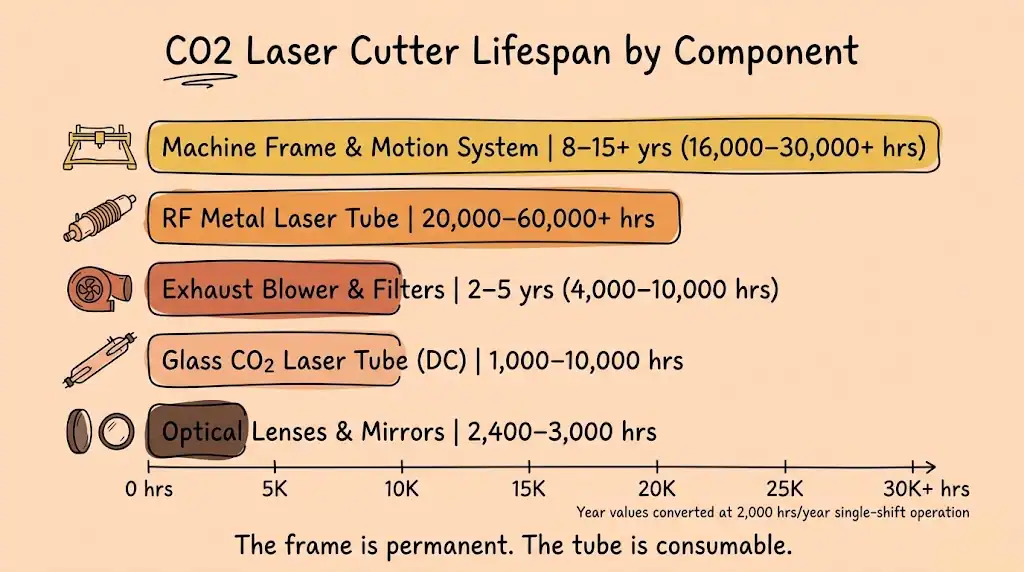
Most people ask "how long does a CO2 laser cutter last?" and expect one answer. There isn't one.
The machine frame itself — the steel chassis, rails, belts, and exhaust — can last a decade or more if you keep it clean and lubricated. We've seen machines from the early 2010s still cutting accurately after 10+ years of service.
But the laser tube? That's a different story. In the CO2 laser world, the tube is treated as a consumable, not a permanent component. Over the life of the machine, you will replace it multiple times. The real question isn't "how long does the machine last?" — it's "how long does each tube last, and what determines that?"
Here's the breakdown:
| Component | Typical Lifespan | Classification |
|---|---|---|
| Machine frame and motion system | 8–15+ years | Permanent (with maintenance) |
| Glass CO2 laser tube (DC) | ~1,000–10,000 hours | Consumable |
| RF metal laser tube | 20,000–60,000+ hours | Consumable (re-gassable) |
| Optical lenses and mirrors | 2,400–3,000 hours | Consumable |
| Exhaust blower and filters | 2–5 years | Replaceable |
The gap between 1,000 and 10,000 hours for a glass tube is massive. That range isn't a dodge — it reflects real differences in tube quality, cooling setup, and daily operating habits. A well-maintained machine with a quality tube and proper cooling can push toward the upper end. A cheap tube run hot and dirty will fail fast.
Glass Tube vs RF Metal Tube: The Real Difference in Lifespan

Not all CO2 laser tubes are built the same. The two main types — glass DC tubes and RF metal tubes — have fundamentally different lifespans, price points, and maintenance profiles.
Glass CO2 laser tubes are the standard in most entry-level and mid-range cutting machines. They're filled with a gas mixture (CO2, nitrogen, helium) and excited by a direct current discharge. When the gas degrades or leaks, the tube loses power and eventually dies. There's no re-gassing option — once it's done, you replace it.
At RedShift Laser, our glass tubes typically run around 8,000 hours under normal operating conditions with proper cooling. Lower-quality tubes from no-name suppliers can degrade in as little as 1,000–3,000 hours, especially if they're run without adequate temperature control.
RF metal tubes use radio frequency excitation instead of DC discharge. The gas is sealed in a metal chamber, and the RF field ionizes it. These tubes cost significantly more upfront — often 5–10x the price of a glass tube — but they last longer and can be re-gassed when performance drops.
Here's how the two compare:
| Factor | Glass DC Tube | RF Metal Tube |
|---|---|---|
| Typical lifespan | ~1,000–10,000 hours | 20,000–60,000+ hours |
| Re-gassable? | No | Yes |
| Upfront cost | Low ($200–$1,500) | High ($2,000–$10,000+) |
| Cooling requirement | Standard chiller (15–25°C) | Precision chiller (tighter tolerance) |
| Power stability | Good | Excellent |
| Beam quality | Good | Superior (better for fine detail) |
| Best for | General cutting, engraving, prototyping | High-volume production, precision work |
The honest answer: most small-to-medium shops don't need an RF tube. A quality glass tube with proper cooling and maintenance will deliver years of reliable service at a fraction of the cost. RF tubes make sense when you're running multiple shifts, need consistent beam quality for precision work, or simply can't afford downtime for tube swaps.
The 4 Things That Kill Laser Tubes Fastest
Laser tube lifespan isn't determined at the factory. It's determined by what you do every day. Here are the four factors that accelerate degradation more than anything else.

1. Cooling Quality
Heat is the enemy. The gas mixture inside a CO2 laser tube breaks down faster at higher temperatures. A basic water pump circulating tap water won't cut it for continuous production.
You need an industrial water chiller that maintains the coolant temperature between 15°C and 25°C. Some operators aim for around 20–22°C as a sweet spot. The water should be distilled or deionized — mineral buildup from tap water will clog the tube's cooling channels and create hot spots.
If your chiller alarm goes off and you ignore it, you're actively shortening the tube's life. Every degree above the safe range accelerates gas degradation.
2. Power Settings and Thermal Stress
Running the tube at 100% rated power for extended periods generates thermal stress that the gas mixture can't recover from. The molecules break down faster, and the output power drops permanently.
For standard production work, cap your operating power at 70–80% of the tube's rated maximum. If you have a 100W tube, run it at 70–80W for routine cuts. Save 100% for occasional thick material or high-speed runs. This single habit can extend stable output by 30–50%.
3. Optics Cleanliness
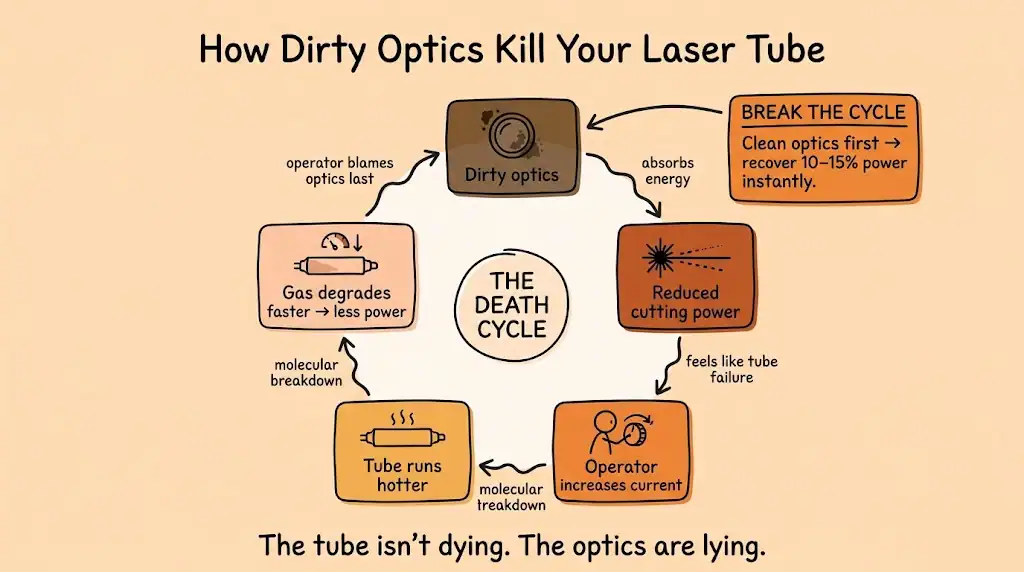
Dust, smoke residue, and carbon buildup on the mirrors and focal lens absorb laser energy before it reaches the workpiece. When the beam weakens, operators often crank up the power to compensate — which stresses the tube even more.
The cycle looks like this: dirty optics → reduced cutting power → operator increases current → tube runs hotter → gas degrades faster → even less power → operator cranks it higher → tube dies early.
Break the cycle by cleaning optics regularly. A clean lens can recover 10–15% of lost power that you thought was tube degradation.
4. Power Stability
Voltage fluctuations, aging high-voltage power supplies, and poor electrical connections cause irregular current delivery to the tube. Spikes can overheat localized areas of the gas. Drops cause the arc to flicker, which also degrades the gas mixture unevenly.
Use a stable power supply rated for your tube's specifications. Check connections periodically. If your cuts start showing inconsistent depth across the bed, check the electrical path before blaming the tube.
Warning Signs Your Tube Is Nearing Its End
CO2 laser tubes rarely fail without warning. Catching these signs early lets you schedule replacement during a planned maintenance window instead of scrambling during a production run.
Decreased penetration. Materials and thicknesses that used to cut cleanly now need slower speeds or higher power. If you've already cleaned the optics and checked alignment, the tube is the likely culprit.
Longer warm-up time. A healthy tube reaches stable output within a few minutes. If your machine now needs 10–15 minutes to settle, the gas mixture is degrading.
Beam instability. Flickering, pulsing, or occasional misfires during continuous operation indicate inconsistent gas ionization.
Poor kerf quality. The cut edge becomes rougher, with more dross or charring, even at previously optimal settings.
The process of elimination. Before concluding the tube is dead, rule out the fixable problems: clean all optics, realign the beam path, verify chiller temperature and flow rate, check electrical connections. If the symptoms persist after all that, it's the tube.
The Hidden Cost of Ownership Nobody Talks About
The purchase price of the machine is only part of the equation. What costs far more over time is unplanned downtime — missed delivery deadlines, rush shipping on replacement tubes, and the hours spent troubleshooting instead of cutting.
A cheap machine with a subpar cooling loop, unstable power supply, and poor exhaust design will cost you more in the first two years than a well-built system costs over five. Here's why:
| Cost Factor | Cheap Machine | Quality Machine |
|---|---|---|
| Tube replacement frequency | Every 6–18 months | Every 2–4 years |
| Unplanned downtime | Frequent (cooling/power issues) | Rare |
| Optics replacement | Accelerated (smoke contamination) | Normal interval |
| Recalibration time | Frequent (alignment drift) | Minimal |
| Resale value | Low | Retains value |
The cooling architecture is the single biggest factor in total cost of ownership. A machine with a proper chiller loop, temperature monitoring, and clean water circulation will protect the tube and pay for itself in extended tube life alone.
How to Extend Your Laser Tube's Lifespan: A Practical Checklist
These aren't theoretical best practices — they're what we tell every RedShift Laser customer during onboarding.
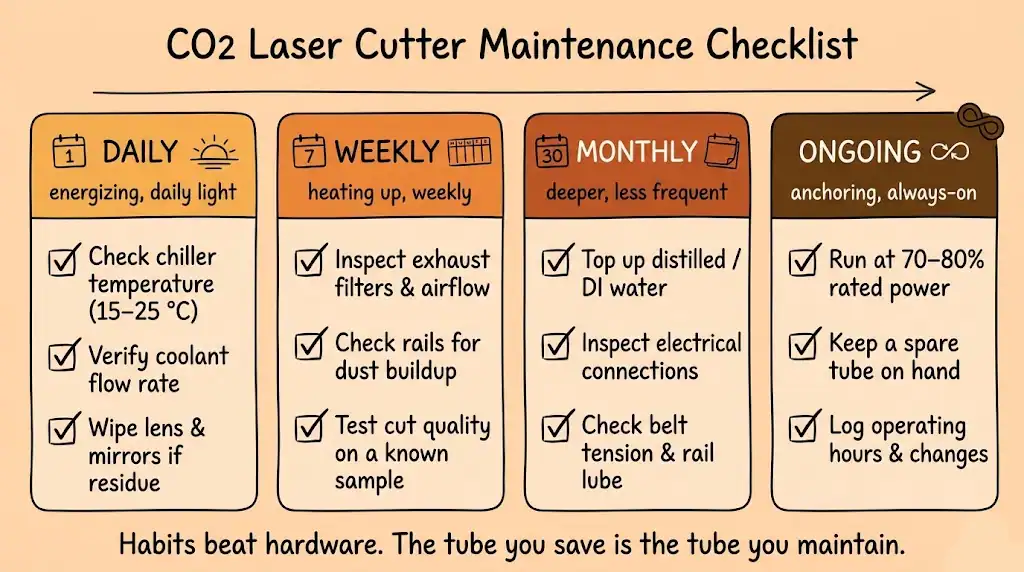
Daily:
- Check chiller temperature before starting (target 15–25°C)
- Verify coolant flow rate
- Clean the lens and mirrors if you notice any residue
Weekly:
- Inspect exhaust filters and airflow
- Check for dust buildup on motion rails
- Test cut quality on a known material sample
Monthly:
- Replace or top up distilled/deionized water
- Inspect electrical connections for corrosion or looseness
- Check belt tension and rail lubrication
Ongoing:
- Run at 70–80% rated power for routine work
- Keep a spare tube in stock if downtime is costly
- Log operating hours and note any performance changes
Quick Reference: CO2 Laser Cutter Lifespan at a Glance
| Metric | Expected Performance |
|---|---|
| Machine frame lifespan | 8–15+ years (with standard maintenance) |
| Glass tube lifespan (quality) | ~8,000 hours (proper cooling and power management) |
| Glass tube lifespan (budget) | 1,000–3,000 hours (poor cooling or continuous max power) |
| RF metal tube lifespan | 20,000–60,000+ hours (re-gassable) |
| Optics lifespan | 2,400-3,000 hours (depends on cleanliness) |
| Biggest lifespan risks | Cooling failure, continuous 100% power, dirty optics, poor exhaust |
| Best prevention | Industrial chiller, 70–80% power cap, regular optics cleaning |
Bottom Line
A CO2 laser cutter's frame can last a decade. The tube inside it won't. The difference between replacing a tube every year and every three years comes down to four things: cooling, power management, optics cleanliness, and electrical stability.
The machines that last are the ones where the operator treats the tube like the consumable it is — not like a permanent component that can be ignored until it fails.
If you're evaluating a purchase, look past the sticker price. Ask about the cooling system. Ask about power supply quality. Ask what the realistic tube lifespan is under your expected duty cycle. The answers to those questions will tell you more about the true cost of ownership than the sales brochure ever will.
*RedShift Laser designs and manufactures CO2 laser cutting systems for industrial production. For questions about machine specifications, tube options, or maintenance protocols, contact our technical team.