Skip to content

You love working with balsa wood for your models and crafts, but cutting it is a constant source of frustration. Hobby knives crush the delicate fibers, saws leave fuzzy edges, and even when you're careful, parts never seem to fit perfectly. You've considered a laser cutter, but you worry it will just burn and char such a lightweight material, leaving ugly, dark edges that ruin the look of your finished project.
Laser cutting is ideal for balsa wood because of its unique cellular makeup. Balsa is mostly trapped air within very large, thin-walled cells. A laser only needs to vaporize these fine cell walls, not dense material, allowing for exceptionally high cutting speeds with low power. This rapid process minimizes heat exposure, resulting in an incredibly clean cut with virtually no charring or burning. It leverages the wood's structure for perfect results.

I remember the first time I demonstrated this to an architectural student. They brought in a sheet of balsa to cut a detailed scale model. They were expecting the dark, burned edges they'd seen on laser-cut plywood. When the machine finished the job in a fraction of the time they expected, they picked up a piece and were shocked. The edge was clean, light tan, and perfectly smooth. "How is there no burn?" they asked. I explained that with balsa, we aren't really burning through wood; we're just popping the walls of tiny air pockets. Let's explore why this works so well.
What is Balsa Wood?
You probably know balsa as that incredibly light wood used in model airplanes and school projects. You might assume its softness is its only important quality. But this common assumption misses the brilliant science behind the material. Without understanding its unique structure, you can't fully appreciate why it behaves so perfectly under a laser beam, and you might not use it to its full potential.
Balsa is a hardwood with an exceptionally low density, prized for its amazing strength-to-weight ratio. This isn't because it's a "weak" wood, but because its cellular structure is fundamentally different from other woods. Balsa's cells are very large and have very thin walls, meaning a piece of balsa wood is mostly comprised of trapped air. This unique composition is the key to its lightness and its remarkable laser-cutting properties.
The Science Behind Balsa's Lightness
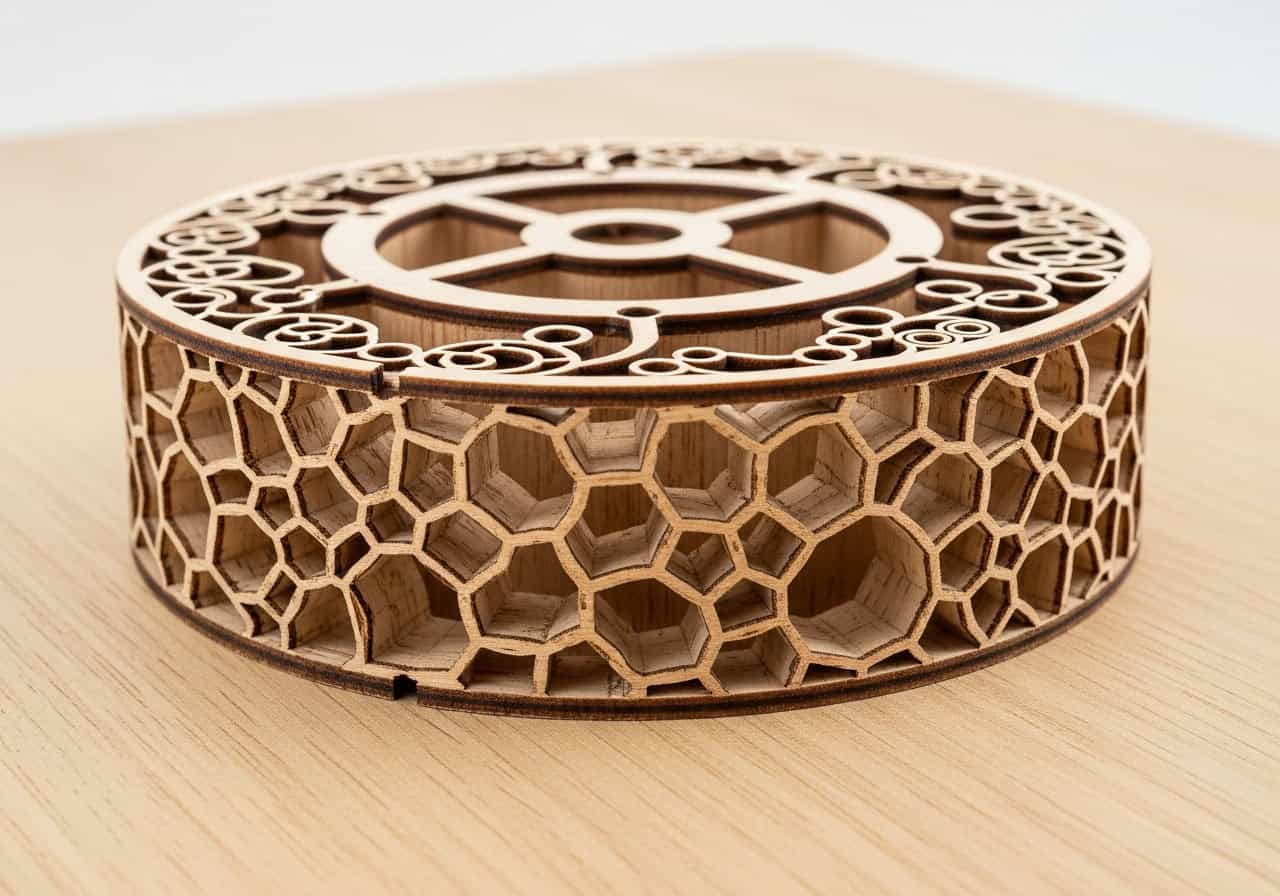
From a materials science perspective, balsa wood is a natural composite foam. When you look at it under a microscope, you don't see dense, tightly packed fibers. Instead, you see a honeycomb-like structure of huge cells. The magic is that the walls of these cells are made of strong cellulose and lignin, but they are incredibly thin. The rest of the volume is just air. This is why a block of balsa feels almost weightless in your hand.
An Unbeatable Strength-to-Weight Ratio
This cellular structure gives balsa its famous strength-to-weight ratio. Think of it like a well-designed bridge truss or a honeycomb. The structure itself provides rigidity and strength, while the empty space keeps the weight to an absolute minimum. This is why it has been a favorite material for everything from model aircraft to the core of surfboards and even some parts of full-sized airplanes.
Where Balsa Comes From
Balsa wood comes from the Ochroma pyramidale tree, which is native to the tropical rainforests of Central and South America. It's one of the fastest-growing trees in the world, which contributes to its low density. The rapid growth creates that large, open-celled structure we value so much.
Balsa vs. Other Craft Woods
| Property | Balsa Wood | Basswood | Pine Wood |
|---|---|---|---|
| Density | Extremely Low (40–340 kg/m³) | Low (320–550 kg/m³) | Medium (350–600 kg/m³) |
| Hardness | Very Soft | Soft | Soft to Medium |
| Grain | Open, large cells | Fine, even grain | Visible, with knots |
| Laser Cutting | Excellent, fast, no char | Very Good, minimal char | Good, moderate char |
What are the Benefits of Laser Cutting Balsa Wood?
You need to create complex, interlocking parts for your models and crafts, but manual cutting is a slow, painstaking process that often leads to frustration. A slight slip of the knife can crush the wood's edge or send a crack through a delicate piece you've spent an hour on. This wastes expensive material and precious time, turning a creative passion into a chore.
Laser cutting balsa wood offers unparalleled benefits, including incredible precision for intricate designs and perfectly fitting parts. The non-contact cutting process eliminates any mechanical stress, preventing crushing or splintering. Most importantly, it produces clean, light-tan edges with almost no burning or charring. This is because the laser moves so fast that there is a virtually non-existent heat-affected zone (HAZ), preserving the material's integrity and appearance.

The Near-Zero Heat-Affected Zone (HAZ)
This is the biggest benefit and it goes back to our core insight. With dense materials like plywood or MDF, the laser has to dwell on the material, pumping in thermal energy to burn through the wood and glues. This creates a noticeable charred edge. With balsa, the laser beam just needs to vaporize the paper-thin cell walls. It can therefore move at an extremely high speed. This high speed-to-power ratio means very little heat is transferred to the surrounding material, resulting in a nearly non-existent HAZ.
Unmatched Precision and Complexity
A laser beam has a tiny spot size (often smaller than 0.1mm). This allows you to cut patterns and shapes that would be physically impossible with a blade. You can create delicate filigree, intricate gears, or perfectly interlocking puzzle pieces. Because the machine is controlled by a digital file, every single part you cut is an exact replica of the last one.
Non-Contact, Stress-Free Cutting
One of the biggest problems with cutting balsa by hand is the physical pressure of the knife blade. It's very easy to crush the soft wood fibers. A laser cuts with light, meaning there is zero mechanical force exerted on the material. The beam simply vaporizes the balsa in its path, leaving the rest of the sheet completely untouched and stress-free.
Laser Cutting vs. Manual Cutting
| Feature | Laser Cutting | Manual Cutting (Hobby Knife) |
|---|---|---|
| Precision | Extremely High (to 0.1mm) | Low to Medium (user dependent) |
| Speed | Very Fast | Very Slow |
| Edge Quality | Clean, No Crushing | Prone to crushing & fuzziness |
| Repeatability | Perfect | Poor |
| Complexity | Virtually Unlimited | Very Limited |
How Does Balsa Compare to Plywood or MDF for Laser Cutting?
You're considering a laser cutter for your workshop and you see many examples of people cutting plywood and MDF. You might wonder if you even need to think about balsa, or if these other engineered woods are a better all-around choice. Without a clear comparison, you could end up choosing a material that is harder to cut, produces more fumes, and gives you a messier result.
When laser cutting, balsa is superior to plywood and MDF for applications requiring speed and clean edges. Plywood and MDF contain adhesive resins that require more laser power to cut, produce more smoke, and leave a dark, charred edge. Balsa, being a natural wood with a low-density cellular structure, cuts much faster with less power and results in a clean, minimally discolored edge, making it ideal for high-finish models and crafts.

The Material Matters
The material you choose has a massive impact on the laser cutting process, including the speed, power settings, and final result. Let's break down the key differences.
Balsa: The Speed King
As we've discussed, balsa's airy structure makes it the easiest and fastest to cut.
- Energy Needed: Very low.
- Edge Finish: Clean, light tan.
- Smoke/Fumes: Minimal, smells like burning wood.
- Best For: Architectural models, model aircraft, intricate crafts.
Plywood: The Strong Workhorse
Plywood is made of thin wood veneers glued together. The laser has to cut through both the wood and the layers of glue.
- Energy Needed: Medium to High. The glue is the hardest part to get through.
- Edge Finish: Dark brown to black char. Can have a sticky resin residue.
- Smoke/Fumes: Moderate to heavy, depending on the glues used.
- Best For: Structural parts, boxes, projects needing more durability.
MDF: The Dense and Uniform Sheet
MDF (Medium-Density Fiberboard) is made from wood fibers mixed with wax and resin, then pressed into a sheet. It's very dense and has no grain.
- Energy Needed: High. It's dense and full of resin.
- Edge Finish: Very dark, sooty black. The edge can be messy.
- Smoke/Fumes: Heavy and unpleasant. Requires very good ventilation.
- Best For: Jigs, templates, paintable projects where the edge is hidden.
Material Cutting Comparison
| Material | Cutting Speed | Power Required | Edge Finish | Ideal Use Case |
|---|---|---|---|---|
| Balsa | Very High | Very Low | Excellent (Clean) | Delicate Models |
| Plywood | Medium | Medium-High | Good (Charred) | Structural Parts |
| MDF | Low | High | Fair (Sooty) | Painted Items, Jigs |
How to Choose the Right Laser Cutting Machine for Balsa?
You're convinced that a laser cutter is the right tool for your balsa projects, but now you're faced with a dizzying array of options. Do you need a high-power machine? What features are essential? Choosing the wrong machine could mean overspending on a powerful laser you don't need, or worse, buying a cheap machine that can't provide the fine control and air assist necessary for clean, char-free balsa cutting.
To choose the right laser cutter for balsa, you don't need high power; a 40W to 60W CO2 laser is more than sufficient. The most critical features are a high-quality Z-axis for precise focusing, excellent low-power control to prevent burning, and a good air-assist system. Air assist is vital as it blows away smoke and prevents flare-ups, which is key to achieving that signature clean, char-free edge on delicate balsa wood.

It's Not About Power, It's About Control
When clients ask me for a machine to cut balsa, they often think they need a lot of power. I always tell them the opposite. For balsa, control is far more important than raw power.
1. Laser Power (40W-60W is Plenty)
Because balsa is so easy to vaporize, you don't need a high-wattage laser tube. A 40W or 60W CO2 laser will cut through even thick sheets of balsa with ease. A higher-power laser (100W+) can actually be harder to control at the very low power levels needed for balsa, making it more likely to burn the wood.
2. High-Quality Focus and Z-Axis
To get the cleanest cut, the laser beam must be perfectly focused on the top surface of the material. A machine with a reliable and easy-to-adjust Z-axis (the up-and-down motion of the bed) is essential. This allows you to set the focal point precisely for different thicknesses of balsa, ensuring the beam is at its most efficient point.
3. The Most Important Feature: Air Assist
If there is one feature you cannot skip for cutting balsa, it's a good air-assist system. This is a small nozzle that directs a jet of compressed air right where the laser is cutting. It does two critical things:
- It blows away smoke and debris, allowing the laser to make a clean cut1.
- It extinguishes any small flare-ups (combustion), which is what causes the charring and dark edges. A good air assist2 is the secret to getting that perfect, light-tan edge.
Conclusion
Balsa wood isn't just ideal for laser cutting because it's soft; it's ideal because of its fundamental structure. Its air-filled, thin-walled cells allow a laser to work at incredible speeds with minimal power, virtually eliminating the charred edges common with other woods. This results in unparalleled precision, clean finishes, and the ability to create complex parts that are impossible by hand. While other materials like plywood and MDF have their uses, balsa stands alone for high-detail models and crafts. By choosing a machine with fine control and good air assist, you can unlock its full potential.
FAQ
Q1: What are the best laser settings for cutting balsa wood?
A: There's no single "perfect" setting, as it depends on your specific machine and the balsa's thickness and density. However, the key principle is always high speed and low power. For a 3mm sheet on a 60W laser, I'd start around 30-40 mm/s speed and only 15-20% power. The most critical setting is to have your air assist on high to get that clean, char-free edge. Always do a small test cut first.
Q2: Can a laser cutter handle thick balsa wood?
A: Yes, absolutely. A standard 40-60W laser can easily cut through balsa up to 1/2 inch (about 12mm) thick. For thicker pieces, you may need to slow the speed down slightly or, for the best edge quality, run two passes at a higher speed. This ensures the beam stays focused and gives you a perfectly vertical cut without charring.
Q3: Is it safe to laser cut balsa wood? What about fumes?
A: It is very safe, provided you have proper ventilation. Balsa is a natural wood, so a laser cutting it produces smoke that smells like a campfire. It doesn't release the toxic fumes you'd get from cutting plastics or woods with heavy resins like MDF. That said, you should always use an exhaust fan that vents to the outside to remove all smoke and particulates from your workspace.
Q4: Can you also laser engrave on balsa wood?
A: Yes, and itengraves beautifully. Because balsa has such a low density, you can achieve a clear, dark engraving with very little power and at extremely high speeds. It's fantastic for adding detailed text, logos, or patterns to your models and crafts. The contrast is excellent, and you don't need to worry about charring like you would with other woods.
Q5: Why am I still getting burnt or charred edges when laser cutting balsa?
A: If you're getting charred edges on balsa, it's almost always one of three things. First, check your air assist; make sure it's on and blowing directly at the cut. Second, your power is too high or your speed is too low. Try increasing the speed significantly. Third, check your focus. An out-of-focus beam is wider and less efficient, essentially "toasting" the wood instead of vaporizing it.