Skip to content

You're running a high-volume production line for woven labels, but you are constantly fighting against waste. Rolls of woven material have tiny, inevitable distortions, causing your die cutter or basic laser to misalign with the print. This results in off-center cuts, rejected batches, and wasted material, all of which directly eat into your profit margins. Manual alignment is too slow and simply not an option for thousands of labels.
The secret to perfectly laser cutting woven labels is using a CO2 laser cutter equipped with a high-resolution CCD camera vision system. This isn't just about the laser's ability to cut. The camera automatically scans the material, identifies registration marks or the outline of each label, and dynamically adjusts the cutting path in real-time to compensate for any stretching or distortion. This guarantees perfect registration on every single label.

I'll never forget a client who manufactured labels for a major sports apparel brand. They had invested in a laser cutter, thinking the sealed edges were the main benefit. But they were still experiencing a 5-7% scrap rate due to misalignment. They were frustrated, thinking the machine was faulty. I visited their facility and showed them that the real problem was the micro-distortions in their fabric rolls. The laser was cutting perfectly straight, but the labels weren't. We upgraded them to a machine with an integrated CCD camera, and their scrap rate dropped to nearly zero overnight. They realized the investment wasn't in a better cutter, but in a foolproof quality control system.
How Does a Laser Actually Cut a Woven Label?
You see the final, perfectly cut label, but the process of getting there seems complex. How does the machine know exactly where to cut, especially when the material isn't perfectly straight? You worry about a complicated setup and a steep learning curve that could slow down your production line instead of speeding it up, making the investment risky.
A laser with a vision system cuts woven labels in a simple, automated three-step process. First, the CCD camera scans the work area to locate each label. Second, the software compares the camera's view to the digital design file, instantly calculating any adjustments needed for position, rotation, or scaling. Finally, the CO2 laser follows this corrected path to cut the label with perfect accuracy and a sealed edge.

The Step-by-Step Vision Cutting Process
From an operator's perspective, the technology is incredibly user-friendly. The machine handles all the complex calculations automatically. Here’s a breakdown of what’s happening inside.
1. The CCD Camera Scan
After the roll of woven labels is fed onto the machine's conveyor bed, the process begins. A high-resolution CCD camera, mounted on the cutting head, moves over the material. It takes a series of high-speed pictures, capturing the position of registration marks printed on the roll or recognizing the outline of the labels themselves. This scan creates a precise, real-world map of the labels on the worktable.
2. Real-Time Software Registration
This is the core of the technology. The machine's software takes the map from the camera and overlays it on your original digital cut file. It instantly identifies any discrepancies—a slight rotation here, a bit of stretching there. It then creates a new, dynamically adjusted cutting path for each individual label, ensuring the cut is perfectly centered every time, regardless of material distortion.
3. The Precise CO2 Laser Cut
With the corrected path locked in, the laser system gets to work. A focused beam of CO2 laser light vaporizes the synthetic threads of the label. This non-contact process is incredibly precise and fast. As it cuts, the heat from the laser melts the edges of the polyester or nylon threads, creating a clean, smooth, and fray-free seal. The entire process, from scan to cut, takes only seconds.
What is the Best Woven Label Laser Cutting Machine?
You are convinced by the technology, but now you face a market full of different machines. How do you choose the right one? Investing in a machine without the correct features—especially the right vision system—is a costly mistake that will leave you with the same alignment problems you're trying to solve, completely defeating the purpose of the upgrade.
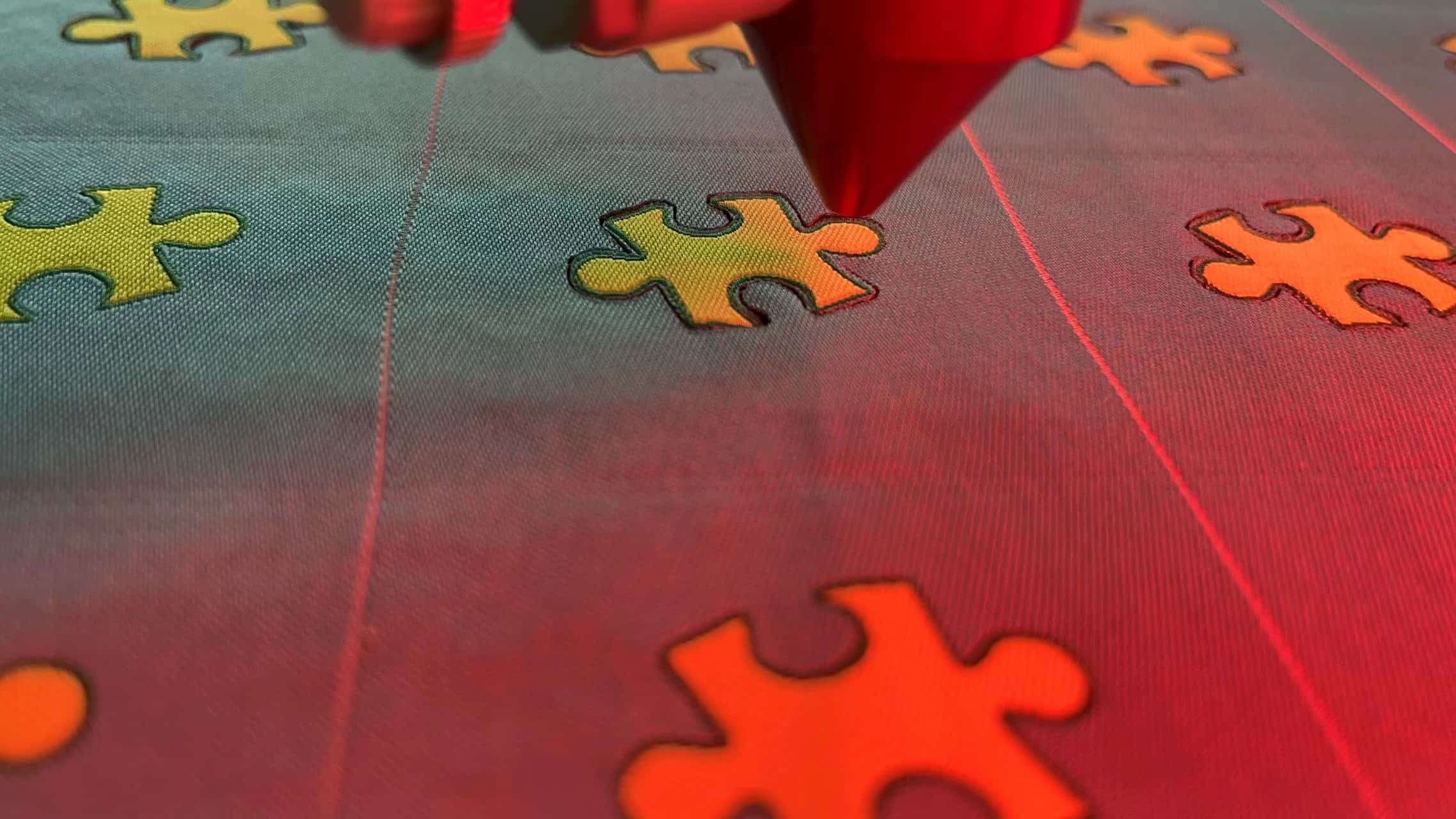
The best machine for woven labels is a CO2 laser cutter with a power of 60-80W, specifically equipped with a high-resolution CCD Vision System. For industrial-scale work, it must also include a conveyor worktable and an automatic feeder to handle material from rolls. The camera is the most crucial component, as it provides the automatic registration needed for high-volume, near-zero-defect production.
Key Features You Must Have
For a purchasing manager like John, the specifications matter. Missing one of these can be the difference between a highly profitable machine and an expensive paperweight.
1. The CCD Vision System (The Most Critical Part)
Do not compromise on this. This is the feature that solves the core manufacturing challenge. A high-quality vision system provides the "eyes" for the machine, allowing it to compensate for material irregularities. It eliminates the need for manual alignment and is the single biggest factor in reducing waste and ensuring consistent quality.
2. CO2 Laser Power (60-80W)
Woven labels are thin materials. You don't need massive power. A 60-80W laser provides the perfect balance of cutting speed and finesse. It's powerful enough for high throughput but controllable enough to create a perfect edge seal without burning or damaging the delicate threads.
3. Conveyor Bed & Auto-Feeder
For high-volume production, you are working with rolls, not sheets. An auto-feeder unspools the material onto the work area, and the conveyor bed automatically advances it after each section is cut. This enables continuous, unattended operation, maximizing your machine's productivity and freeing up your staff for other tasks.
Machine Comparison for Label Cutting
| Feature | Basic CO2 Laser | Laser with CCD Vision | Die Cutter |
|---|---|---|---|
| Registration Accuracy | Poor (Manual) | Excellent (Automatic) | Fair (Prone to Drift) |
| Material Waste | High | Near-Zero | Medium to High |
| Edge Quality | Good (Sealed) | Excellent (Sealed) | Poor (Frayed) |
| Design Flexibility | High | High | None (Fixed Die) |
| Setup Time | Medium | Fast (Automated) | Long (Die Change) |
| Ideal Use Case | Prototyping | High-volume Production | Mass single-shape runs |
What are the Advantages of Laser Cutting Woven Labels?
You need to justify the investment in a new machine to your team and stakeholders. What are the tangible benefits that will show up on the bottom line? Without a clear understanding of the return on investment, it's hard to get approval for a capital expenditure, even if the technology is superior.
The primary advantage is dramatically reduced waste from misalignment, which is a far bigger operational cost than frayed threads. Thanks to the CCD camera, you get near-perfect cutting accuracy. The secondary benefits are also significant: clean, fray-free sealed edges that enhance product quality, incredible design flexibility without tooling costs, and a high-speed, automated process that boosts overall production efficiency.

A Focus on Operational Gains
While everyone loves a clean edge, a purchasing manager cares about the numbers. Here’s how this technology impacts the business.
Near-Zero Waste from Misalignment
This is the biggest financial win. If your current scrap rate from misaligned cuts is 5%, a vision laser system can bring that down to less than 0.5%. Over a year of production, this represents a massive saving in both material costs and labor hours spent on quality control. The vision system pays for itself by eliminating this waste.
The Fray-Free Edge as a Quality Guarantee
While it might be a secondary benefit from a production cost perspective, the sealed edge is a primary benefit for your customer. Frayed labels look cheap and can unravel over time. A perfectly sealed, smooth edge looks professional and lasts longer, reflecting the quality of the garment or product it's attached to. This directly enhances your brand's reputation.
Unmatched Design Freedom
With die cutting, you are locked into one shape per die. If a client wants a new or complex label shape, you have to invest time and money into new tooling. With a laser, you can switch from cutting a simple rectangle to an intricate crest shape with a simple file change. This allows you to say "yes" to more custom jobs and prototype new designs instantly.
What Kinds of Labels and Patches Can You Laser Cut?
You're considering this technology for woven labels, but could it handle other materials in your production line? You need a versatile machine that can adapt to different jobs and materials. Investing in a one-trick pony limits your capabilities and reduces the overall return on your investment, a key concern for any procurement expert.
A CO2 laser cutter with a vision system is incredibly versatile. It's perfect for woven labels, printed fabric labels, and embroidered patches, as the camera can recognize printed outlines or stitched borders. It's also ideal for kiss-cutting adhesive-backed materials like twill patches or vinyl stickers, and for precisely cutting sublimation-printed fabrics, ensuring the cut perfectly follows the printed design every time.

Exploring the Versatility
This technology opens up a wide range of applications, often allowing one machine to replace several different processes.
- Woven & Printed Labels1: The classic application. The camera recognizes the artwork for a perfect cut2.
- Embroidered Patches3: The vision system can accurately trace the stitched merrow border4 of a patch, cutting it out perfectly without touching the embroidery.
- Kiss-Cut Stickers5 & Twill: For adhesive-backed materials, the laser power can be controlled to cut through only the top layer, leaving the backing paper intact. This is ideal for producing peel-and-stick patches6 or sticker sheets.
- Dye-Sublimation Cutting7: This is a huge market. For sportswear and banners, fabrics are printed first and then cut. The vision system8 finds the outline of the printed design and cuts it out perfectly, eliminating any white edges and ensuring graphics are perfectly aligned.
Conclusion
When it comes to cutting woven labels, the conversation must go beyond just sealed edges. The true challenge in high-volume manufacturing is registration accuracy. The solution is not just a laser, but a laser integrated with a CCD camera vision system. This technology tackles the core problem of material distortion head-on, virtually eliminating waste from misalignment. For a purchasing manager, this translates to direct savings, higher throughput, and impeccable quality control. The sealed edge is a fantastic bonus, but the real innovation—and the real return on investment—lies in the machine's ability to see and adapt.
FAQ
Q1: Is the CCD camera vision system really necessary, or can I get by with a standard laser cutter?
A: From my experience, for any kind of high-volume production, the CCD camera is not just a feature—it's the entire solution. You can certainly cut labels with a standard laser, but you will still face the same costly misalignment and waste problems you have now. A standard laser cuts a perfect digital path, but it has no way of knowing if the material underneath has stretched or shifted. The vision system is what pays for the machine by cutting your scrap rate from several percent down to almost zero.
Q2: How does a vision laser's speed compare to a traditional die cutter for high-volume production?
A: This is a great question that comes down to "throughput" versus "speed." On a simple, single shape, a die cutter's stamping speed is faster. However, the vision laser often wins on overall daily throughput. Why? The laser system has virtually zero setup time—you just load a new file. There's no downtime for changing heavy dies. A conveyor system automates material handling. When you factor in the elimination of waste and the flexibility to change jobs instantly, the laser's total output is significantly higher.
Q3: We also work with embroidered patches and printed fabrics. Can this same machine handle those?
A: Absolutely. This is one of the biggest advantages. The same vision system that recognizes printed registration marks on a woven label can also be programmed to recognize the stitched merrow border of an embroidered patch. For dye-sublimated fabrics, like sportswear, it's a game-changer. The camera finds the outline of the printed graphic and cuts it perfectly, ensuring no white edges. This versatility makes it a much better long-term investment than a single-purpose die cutter.
Q4: Are there any label materials that are not suitable for laser cutting?
A: Yes, and this is an important distinction. CO2 lasers are ideal for synthetic materials like polyester, nylon, and polypropylene because the laser melts the fibers to create that perfect sealed edge. It is not recommended for labels made from natural fibers like cotton, leather, or wool. These materials tend to char and burn rather than melt cleanly, which can leave a discolored, sooty edge and a noticeable odor. Always confirm your label material is synthetic.
Q5: What is the learning curve like for an operator transitioning from a die cutter to this automated system?
A: The transition is surprisingly smooth. While the technology is advanced, the user interface is designed for simplicity. A die cutter requires significant physical skill and setup. The vision laser system automates the most difficult part—the alignment. An operator's job shifts from manual alignment and setup to loading material and selecting the correct file on a computer. Typically, an operator can be trained to run the machine confidently and efficiently within a day or two.
Relate
-
Explore this link to understand the versatility and uses of Woven & Printed Labels in various industries. ↩
-
Discover the technology behind achieving a perfect cut, enhancing the quality of printed labels. ↩
-
Explore this link to understand how embroidered patches can enhance your designs and add a unique touch. ↩
-
Learn about the merrow border's significance in embroidery and how it contributes to the quality of patches. ↩
-
Explore this link to understand the unique production process and benefits of Kiss-Cut Stickers. ↩
-
Discover the various applications and advantages of peel-and-stick patches in this informative resource. ↩
-
Understanding Dye-Sublimation Cutting can enhance your knowledge of fabric printing and cutting technologies, crucial for design and manufacturing. ↩
-
Exploring how vision systems operate can provide insights into automation in manufacturing, improving efficiency and precision in production. ↩