Skip to content

You're excited to produce highly detailed rubber stamps, but halfway through a job, the quality plummets. The crisp lines from the first few stamps have turned blurry and shallow. You find yourself constantly increasing the power settings, the machine smells terrible, and you're wasting expensive rubber sheets on inconsistent results. You're left wondering if your professional machine is somehow failing.
The problem isn't your machine; it's the aggressive byproduct of engraving rubber. The process creates a fine, oily soot that rapidly coats your laser's lens and mirrors. This sticky film absorbs the laser's energy, causing a dramatic drop in power and focus. The secret to consistent, high-quality rubber engraving is a workflow built around mandatory optics cleaning and industrial-grade fume extraction.

I remember a client who ran a successful online craft supply store. They bought one of our lasers to start producing custom rubber stamps. A week later, they called me, completely frustrated. "The machine works great for ten minutes, then it just gets weaker and weaker!" they said. I didn't ask about their designs or software. I asked one question: "When was the last time you cleaned your focusing lens?" After a long pause, they admitted they hadn't cleaned it at all. That oily soot is the number one enemy of rubber engraving. Once they started cleaning the lens after every short run, their quality became perfectly consistent.
What Makes Rubber a Unique Challenge for Laser Engraving?
You've successfully engraved wood and acrylic, and you assume rubber will be just as straightforward. But when you try it, the process is messier than you expected. A thick, sticky residue builds up inside your machine, and the smell is far more intense. You quickly realize that your standard operating procedure isn't going to work for this material.
Rubber presents a unique challenge because its chemical composition causes it to ablate into a heavy, oily soot, unlike the dry dust from wood or clean vapor from acrylic. This aggressive byproduct actively degrades machine performance by coating the optics. Furthermore, the fumes are particularly noxious and hazardous, demanding a higher level of fume extraction than other common materials.

Understanding the Material's Behavior
For a purchasing manager like John, understanding why a material behaves a certain way is key to managing production costs and risks. The "art" of rubber engraving is mostly the science of controlling its messy byproducts.
1. The Science of Rubber Ablation
When the CO₂ laser beam strikes the rubber, it doesn't just cut or melt; it causes "ablation," meaning the material is instantly vaporized. However, rubber compounds (whether natural or synthetic) contain oils, carbon black, and other fillers. These additives turn into a fine, sticky, aerosolized soot, not a clean gas.
2. Optics Contamination: The Primary Enemy
This oily soot is your biggest technical problem. It gets pulled towards the exhaust but also settles on every surface inside the machine, including the most critical components: the mirrors that guide the beam and the final focusing lens. This residue film is a power-killer. It absorbs the infrared energy from the laser, heating the optic itself and preventing the full power from reaching the rubber. This directly causes shallow, blurry engravings.
3. Fume Hazard: More Than Just a Bad Smell
The odor from laser-engraved rubber is a clear warning sign. The fumes contain volatile organic compounds (VOCs) and other potentially hazardous particulates. A simple exhaust fan that vents out a window is often insufficient. For safe and compliant operation, especially in a professional setting, an industrial-grade fume extraction system with activated carbon and HEPA filters is essential. This protects your staff and prevents the workshop from filling with harmful, smelly air.
Byproduct and Maintenance Comparison
| Feature | Wood | Cast Acrylic | Laser Rubber |
|---|---|---|---|
| Byproduct Type | Dry, smoky dust and resin | Clean vapor, minimal residue | Heavy, oily, sticky soot |
| Impact on Optics | Moderate dust coating | Very low, slight haze over time | High, rapid oily film buildup |
| Fume Hazard | Moderate smoke | Strong but less hazardous odor | High, noxious/hazardous fumes |
| Cleaning Frequency | Weekly / Bi-weekly | Monthly | Daily / Per-session |
Where Can Laser-Engraved Rubber Boost Your Business?
You might think that the market for rubber stamps is limited to basic office supplies and hobby crafts. This narrow perspective makes you question whether investing in the capability is worth it. You are hesitant to adopt a process if you can't see a clear path to significant and diverse revenue streams.
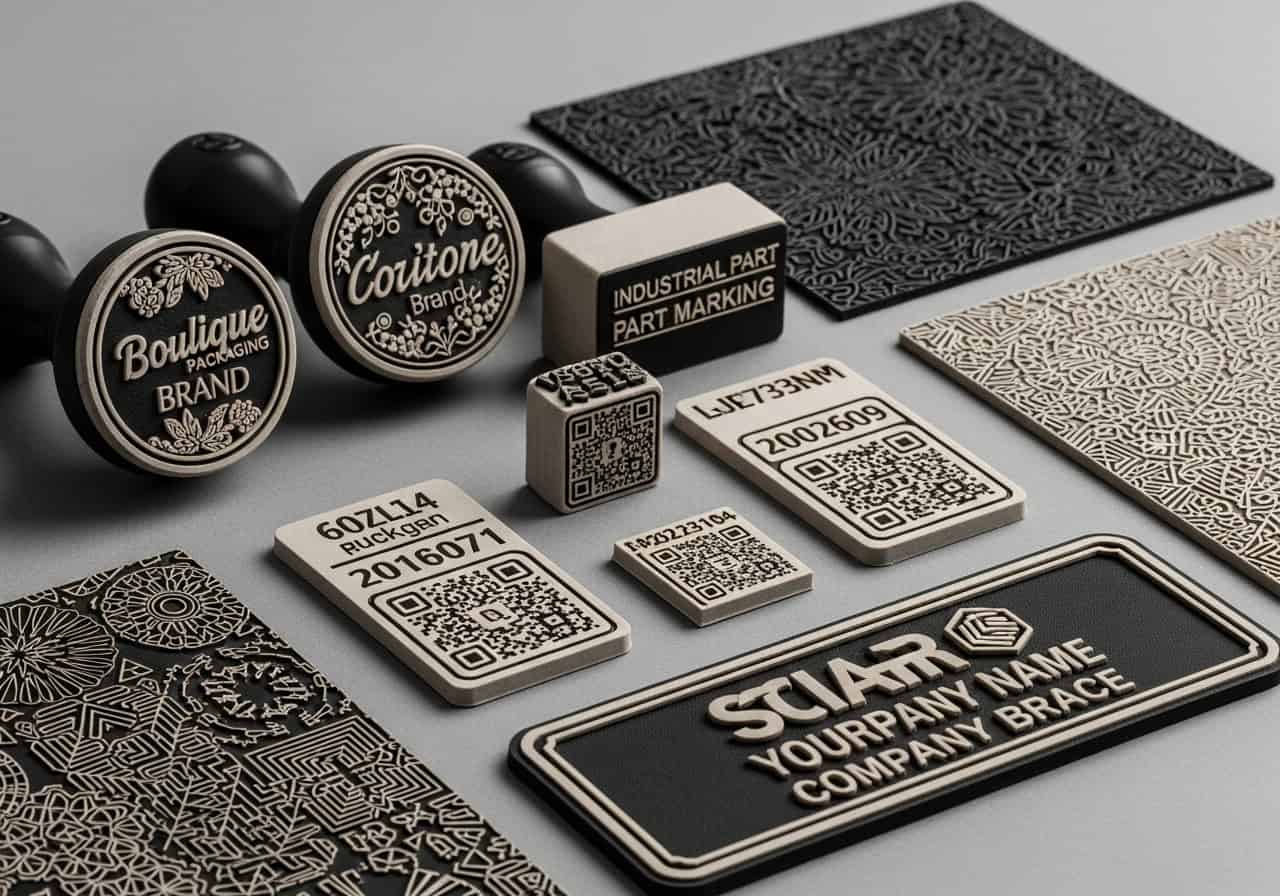
Laser-engraved rubber offers a wide range of high-value applications well beyond the craft market. These include custom brand stamps for boutique packaging, industrial part marking and coding, creating textural skins for product prototyping, and producing specialized signage. For businesses looking to diversify, this capability opens doors to profitable niche markets that value customization and precision.
Finding High-Value Opportunities
Profitability comes from applying the technology to solve valuable problems for other businesses. Here are some markets where custom rubber engraving is in high demand.
1. Custom Packaging and Branding
Think of small bakeries, coffee roasters, and e-commerce shops. They need an affordable way to brand their paper bags, boxes, and cups. A custom-engraved rubber stamp with their logo is a perfect solution. It's rustic, reusable, and far cheaper than ordering thousands of custom-printed boxes. This is a huge and growing market.
2. Industrial Part Marking
In manufacturing, parts often need to be marked with date codes, serial numbers, or quality control insignia. A custom rubber stamp mounted in an automated or manual jig is a durable and reliable way to apply these marks using industrial inks.
3. Architectural and Design Prototyping
Architects and industrial designers often create scale models. They can use laser-engraved rubber sheets to simulate textures like brickwork, paving stones, or specific material finishes. This allows them to create highly detailed and realistic models for client presentations.
What Are the Real Advantages of Laser Engraving Rubber?
You are considering different methods for creating stamps, like traditional photopolymer processes. You see that lasers offer speed, but you are not sure if the benefits outweigh the challenges of residue and fumes. You need to know if the laser provides a clear, measurable advantage in terms of quality, efficiency, and overall cost.
The main advantages of laser engraving rubber are speed and precision. A laser can produce a finished, deeply engraved stamp with fine details in minutes, directly from a digital file, with no chemicals or water washout required. This one-step process allows for rapid prototyping and on-demand production of even the most complex designs, offering superior flexibility over traditional methods.

A Clear Look at the Benefits
While the maintenance demands are real, so are the payoffs in production capability.
1. Unmatched Speed and Simplicity
Traditional photopolymer stamp making is a multi-step process involving film negatives, UV exposure, chemical baths, and water washout, which can take up to an hour. A laser engraver takes a digital design and produces a finished stamp in a single step, often in less than 15 minutes. This "file-to-part" speed is a massive competitive advantage.
2. Superior Detail and Depth
A laser can create incredibly fine details, sharp text, and deep, sloped shoulders on the stamp characters. This depth and shaping are critical for producing clean, crisp impressions without smudging. The laser offers a level of control over the engraving Z-axis (depth) that is difficult to achieve with other methods.
3. Chemical-Free Process
The fact that laser engraving is a dry, chemical-free process is a significant benefit. It eliminates the cost, storage, and disposal challenges associated with photopolymer chemicals. This makes the workplace safer, simplifies regulatory compliance, and is a more environmentally friendly method.
How Do You Elevate Your Production with the Right Features?
You are ready to invest in a laser for rubber engraving, but the technical specifications are confusing. You're worried about choosing a machine that isn't properly equipped to handle the unique challenges of rubber. Buying the wrong machine could lead to poor performance, safety hazards, and constant frustration for your team.
To elevate rubber engraving production, prioritize three features. First, a high-quality air assist is non-negotiable to protect the lens from oily soot and prevent fires. Second, an industrial-grade fume extraction system is essential for safety and air quality. Finally, a machine with easily accessible optics significantly simplifies the frequent cleaning that rubber engraving demands, turning a chore into a quick routine.

Focusing on Features That Matter for Rubber
Let's ignore the generic marketing points and focus on the machine highlights that specifically solve the problems of rubber engraving.
1. A High-Performance Air Assist
Air assist is a jet of compressed air directed at the engraving point. For rubber, this is a critical defensive feature. It does two things: it creates a positive pressure barrier that helps blow the oily soot away from the focusing lens, keeping it cleaner for longer. It also instantly extinguishes any small flare-ups from the hot rubber, acting as a crucial fire prevention tool.
2. A Dedicated Fume Extractor
As we've established, the fumes are a major issue. Do not rely on a simple inline fan. A true fume extraction unit is a separate machine with a multi-stage filtration system. It typically includes a pre-filter for large particles, a HEPA filter for fine soot, and a deep bed of activated carbon to absorb the hazardous VOCs and neutralize the odor. This is a non-negotiable investment for professional rubber engraving.
3. Design for Maintainability
Given that you will be cleaning your optics frequently, how easy they are to access matters. A well-designed machine allows you to release the lens holder and remove the mirrors without tools in just a minute or two. This "design for maintainability" turns a dreaded task into a quick, simple part of the workflow, maximizing uptime and ensuring consistent quality.
Conclusion
Successfully integrating laser engraving for rubber into your business hinges on looking past the finished stamp and focusing on the process itself. The real art lies not in the design, but in mastering the operational challenges of a material that produces aggressive, oily soot and noxious fumes. By prioritizing a powerful air assist, industrial fume extraction, and a disciplined optics cleaning schedule, you can conquer these challenges. This expert approach transforms rubber engraving from a frustrating, inconsistent process into a highly reliable, safe, and profitable production capability.
FAQ: Laser Engraving Rubber
Q1: Can I engrave any type of rubber I find at a hardware store?
A: Absolutely not. This is a critical safety issue. Many types of standard rubber, especially those containing PVC (Polyvinyl Chloride) or vinyl, release corrosive chlorine gas when burned by a laser. This gas can permanently damage your machine's optics, metal components, and electronics, and is extremely hazardous to your health. Always use rubber specifically designated as "laser-safe" or "laserable."
Q2: Why does my engraving quality get worse and weaker after just a few stamps?
A: This is the most common issue with rubber engraving. The cause is a buildup of oily soot on your laser’s focusing lens and mirrors. This residue absorbs the laser's energy, preventing the full power from reaching the rubber and causing the beam to lose focus. Frequent, mandatory cleaning of the optics is the only solution.
Q3: How often do I really need to clean my optics when engraving rubber?
A: Much more frequently than with any other material. As a rule of thumb, inspect your focusing lens after every 30-60 minutes of engraving time. For mirrors, a daily check and cleaning are recommended. If you see any hazy or oily film, clean it immediately.
Q4: The smell from engraving rubber is very strong. Is an open window enough for ventilation?
A: No. The fumes are not just smelly; they are hazardous. An open window or a simple bathroom-style exhaust fan is insufficient. You need an industrial-grade fume extraction system with pre-filters, a HEPA filter for particulates, and a deep bed of activated carbon to capture the harmful VOCs. This is a non-negotiable safety requirement for professional use.
Q5: What are good starting settings for engraving a rubber stamp?
A: For a 60-80W CO₂ laser, a good starting point is around 15-25% power at a high speed of 400-500 mm/s. The goal is to vaporize the rubber cleanly without melting it. Always run a small test on a scrap piece to fine-tune your settings for the specific rubber you are using.
Q6: How do I create a good 'shoulder' on the stamp for a cleaner impression?
A: A "shoulder" is a slight angle on the sides of the engraved characters, which adds support and prevents ink from catching on the edges. Many laser software programs (like LightBurn) have a "Ramp" or "Shoulder" setting that automatically varies the power to create this effect. You can also achieve it by running the job with multiple passes at slightly different focus levels or power settings.
Q7: Is air assist necessary for engraving rubber?
A: Yes, it is absolutely essential. A strong jet of compressed air at the engraving point does two critical jobs: it helps blow the oily soot away from your lens, keeping it clean for longer, and it suppresses flare-ups, significantly reducing the risk of fire.
Q8: My engraved rubber looks sticky or melted. What did I do wrong?
A: This is usually a sign of using too much power or too slow a speed. The laser is melting the rubber instead of cleanly vaporizing (ablating) it. Try reducing your power or increasing your engraving speed. A dirty lens can also contribute to this problem, as it forces you to use higher power settings than necessary.
Q9: What is the difference between "laser rubber" and regular rubber?
A: Laser-safe rubber is specifically formulated to ablate cleanly with minimal residue and, most importantly, does not contain PVC or other harmful compounds. "Low-odor" laser rubber includes additives that help neutralize some of the smell during the engraving process, making the work environment more pleasant.
Q10: After engraving, there is a lot of black soot on the stamp. How do I clean it?
A: The finished stamp will be covered in soot. The best way to clean it is to use a soft brush (like an old toothbrush) with some water and a mild detergent or specialized stamp cleaner. Gently scrub the surface until all the loose residue is gone, then rinse and let it dry completely before use.